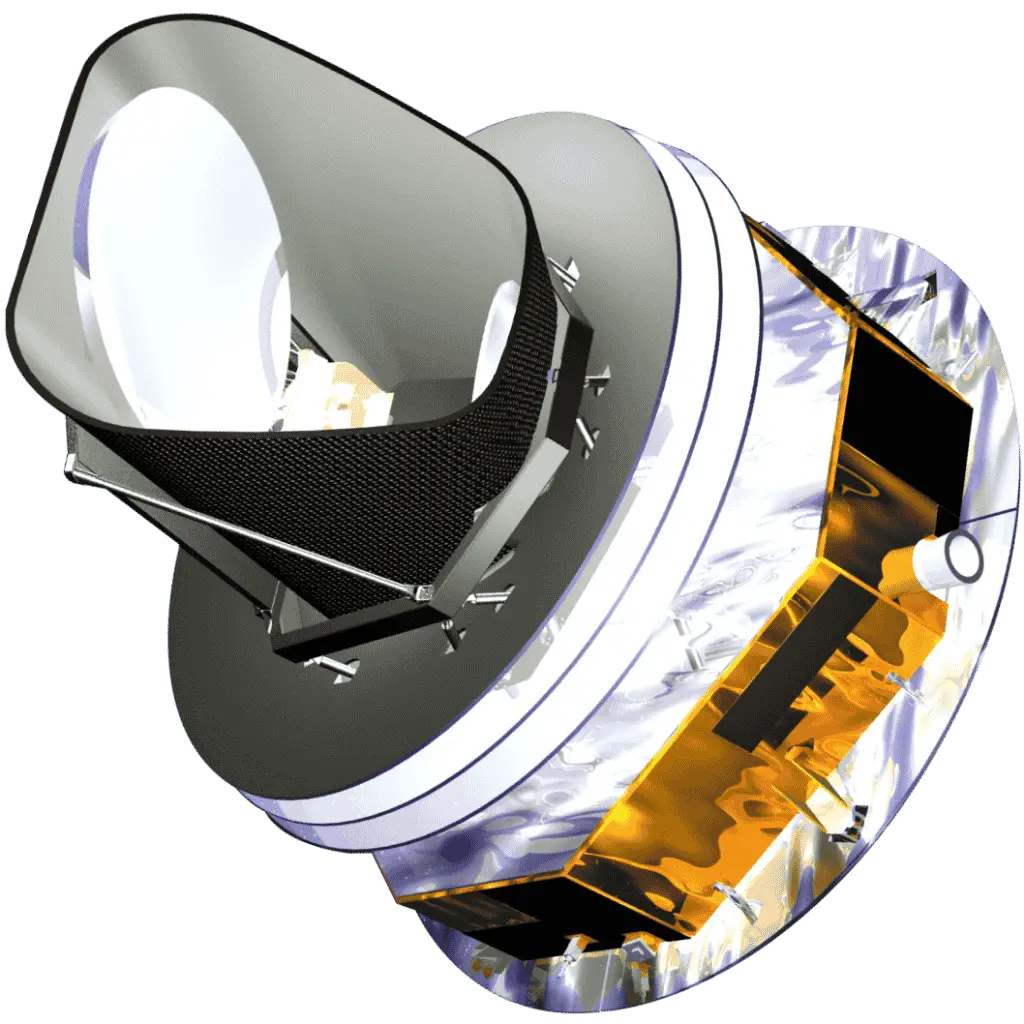
Planck Observatory

Cosmic Background Explorer

Microwave telescope studying the early universe

Planck Observatory

Cosmic Background Explorer

Microwave telescope studying the early universe

Agency
ESA
Mission Cost
$0.9B
Target Objects
CMB
Launch Date
2009-05-14
Instrument Type
Radiometer
Mirror Size
1.5 m
Resolution
5 arcmin
Data Output
0.1 TB/year

USPs

  • Maps Cosmic Microwave Background with high precision
  • Located at L2 for stable observations
  • Refines cosmological parameters like universe’s age
  • Coldest operational temperature (0.1 K) for sensitive measurements
  • Dual instruments: High Frequency Instrument (HFI) and Low Frequency Instrument (LFI)
  • Provided polarization data for deeper insights into cosmic structure
  • Helped confirm the standard model of cosmology

Major Milestones

  • 2009-05-14: Launched aboard an Ariane 5 rocket from Kourou, French Guiana, alongside Herschel, marking the start of its mission to study the cosmic microwave background.
  • 2009-07-03: Reached the L2 Lagrangian point and entered a Lissajous orbit, achieving the coldest operational temperature of 0.1 K for its instruments.
  • 2009-08-13: Began its first all-sky survey, initiating detailed mapping of the cosmic microwave background with high sensitivity and resolution.
  • 2010-02: Completed its first all-sky survey and started a second survey, exceeding initial expectations for data collection.
  • 2011-01: Released the Early Release Compact Source Catalogue (ERCSC), providing the astronomical community with initial data on foreground sources.
  • 2012-01-13: Exhausted its helium-3 coolant, rendering the High Frequency Instrument (HFI) unusable, though the Low Frequency Instrument (LFI) continued operations.
  • 2013-03-21: Released the first all-sky map of the cosmic microwave background, offering unprecedented detail on the early universe’s temperature variations.
  • 2015-02: Published an expanded data release including polarization data, enhancing understanding of the universe’s structure and evolution.
  • 2018-07: Released final papers and data, concluding the mission with the most precise measurements of the universe’s age, geometry, and composition.
  • 2025-07-17: Data continues to be analyzed, influencing ongoing cosmological research despite the observatory’s decommissioning in 2013.

Cosmic Portrait

Mapping the Big Bang: The Legacy of the Planck Observatory

Imagine looking at a baby picture of the entire universe. It’s not a clear photo with stars and galaxies, but a mottled map of heat and cold from 13.8 billion years ago. The Planck Observatory spent years capturing this light to help us understand where everything began. It doesn’t just study stars: it studies the raw material that became everything we see today. We’re finally getting a clearer look at the blueprints of space itself.

What’s the Planck Observatory?

The European Space Agency (ESA) led this ambitious mission with help from NASA. Launched in May 2009, this high-tech satellite traveled far from Earth to the second Lagrange point (L2). It isn’t a typical telescope that looks at visible light like Hubble. This machine is a surveyor of the ‘cold’ sky, detecting radiation left over from the birth of time. A simple way to view it: it’s a massive, ultra-sensitive thermometer floating 1, and 5 million kilometers away in the darkness of space.

Purpose and Mission Objectives of the Planck Observatory

Scientists built the satellite with specific targets in mind to resolve old debates about the cosmos. The primary goal involved measuring the Cosmic Microwave Background (CMB) with unprecedented precision.

  • Map the CMB: Create a high-resolution chart of temperature fluctuations in the early universe.
  • Test Inflation: Provide data to prove or disprove theories about how the universe expanded in its first seconds.
  • Identify Matter: Determine the exact ratio of normal matter, dark matter, and dark energy.
  • Galaxy Mapping: Study the dust and gas within our own Milky Way galaxy.

Key Discoveries of the Planck Observatory

Planck’s data provided the most accurate ‘recipe’ for the universe we’ve ever had. It revealed that ordinary matter (the stuff that makes up stars, planets, and people) accounts for only 4.9% of the cosmos. Dark matter makes up about 26.8%, which is more than we previously thought. Dark energy, the mysterious force pushing the universe apart, makes up the remaining 68.3%. I’ve consistently noticed that most public debate about the age of the universe centers on the discrepancy between Planck’s data and recent local measurements of the Hubble constant.

The mission also updated the age of our universe. Earlier estimates were slightly off, but the