Penrose Process: Ultimate Way to Harvest Black Hole Energy
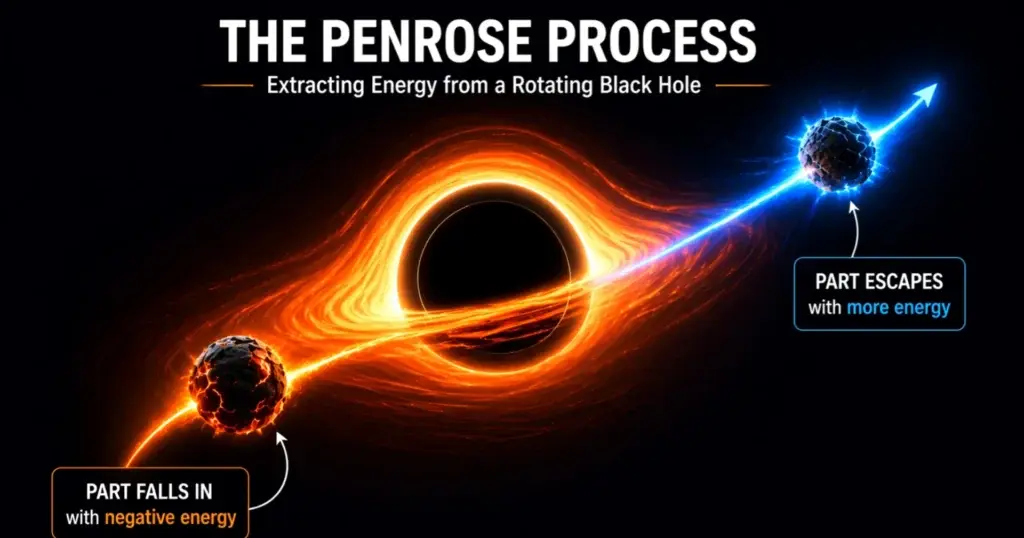
A rotating black hole can theoretically power civilizations.
Tags:
- black hole
- Penrose Process
Black holes are often seen as cosmic vacuum cleaners where nothing escapes. We’re taught that anything passing the event horizon is gone forever. But that’s only half the story. If a black hole is spinning, it has a region called the ergosphere where the rules of space and time get weird. Scientists believe we could use the Penrose Process to dive into this region and come back with more energy than we started with. It sounds like science fiction, but the math says it’s physically possible. But here’s the real question: if the energy is there… how would you actually take it? And more importantly, how far could you push it before the black hole itself starts to slow down?
The Penrose Process is a theoretical method of extracting energy from a rotating black hole by using its ergosphere, allowing particles to escape with more energy than they entered with.
Can Energy Really Be Extracted from a Black Hole?
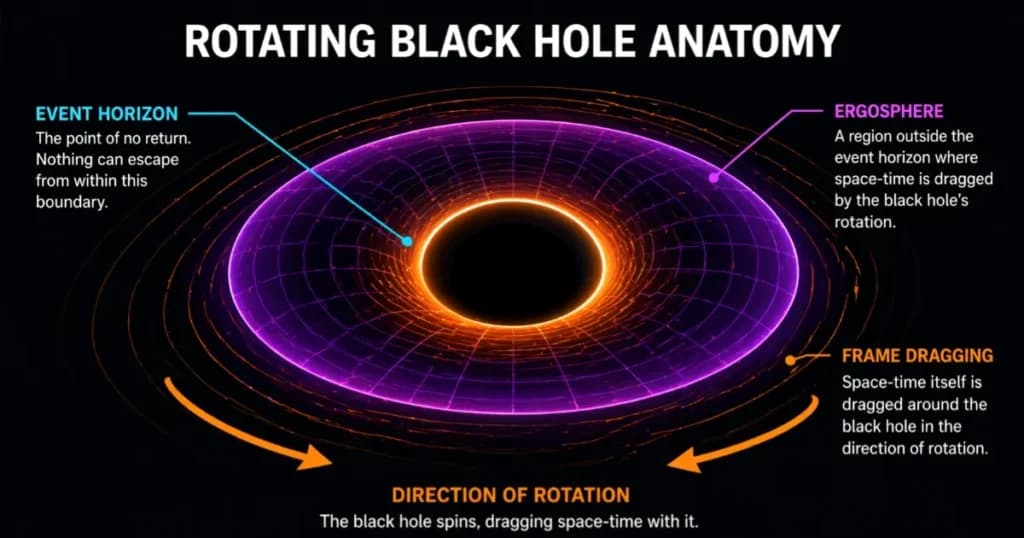
It depends on whether the black hole is “quiet” or spinning. A stationary black hole is just a pit. A rotating black hole, known as a Kerr black hole, is more like a massive flywheel. Since it’s spinning at incredible speeds, it drags space-time itself along with it. This dragging of the cosmic fabric means the black hole has enormous amounts of rotational kinetic energy. In practice, this energy isn’t locked behind the event horizon. It’s stored in the warped space just outside the point of no return (you can explore how this boundary actually looks in our detailed guide on black hole shadows), and we can tap into that. This strange region where energy can be accessed is called The Ergosphere, and it’s the only reason any of this is even possible.
What Is the Penrose Process (And Why It Works)
Proposed by physicist Roger Penrose in 1969, this idea is rooted in Einstein’s theory of general relativity.
The Penrose Process relies on a unique area called the ergosphere. This is an oval-shaped region just outside the event horizon. In this zone, the black hole forces everything to rotate in the same direction it’s spinning. You literally can’t stand still here, no matter how powerful your engines are. Space-time is moving too fast. If you enter this zone and throw an object into the black hole against its rotation, something incredible happens to the conservation of energy. This effect is known as frame dragging, where space-time itself is pulled along by the black hole’s rotation.
The math works by splitting an object in two while it’s inside the ergosphere. You drop a “sacrificial” piece of mass into the event horizon in a way that gives it negative energy relative to an outside observer. According to NASA researchers, mass and energy are linked. When the black hole eats that negative-energy piece, its total mass actually decreases. The piece you keep, the one that flys back out, comes back with more energy than the original whole object had. You’ve successfully stolen part of the black hole’s momentum. This isn’t just theoretical speculation. The equations describing this come directly from Einstein’s theory of general relativity and have been studied for decades in astrophysics.
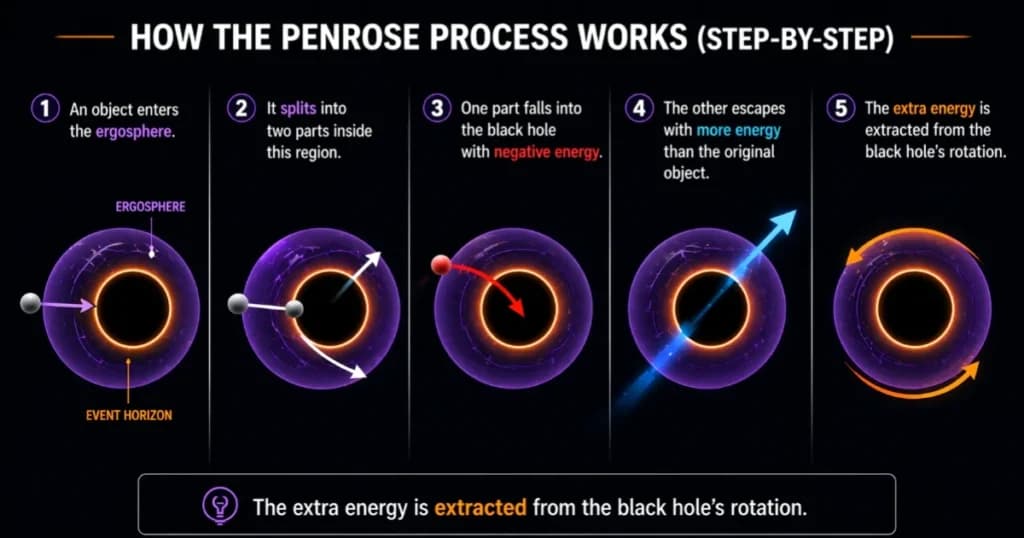
How the Penrose Process Works (Step-by-Step):
- An object enters the Ergosphere of a rotating black hole
- It splits into two parts inside this region
- One part falls into the black hole with negative energy
- The other escapes with more energy than the original object
- The extra energy is extracted from the black hole’s rotation
How an Advanced Civilization Could Harness a Black Hole
Scaling this up requires more than just throwing rocks into the void. In my own review of Dyson-sphere-style megastructures, I’ve found that the most efficient way to use the Penrose Process is the “Black Hole Bomb.” Instead of physical objects, a civilization would use light or electromagnetic waves. You build a massive mirror around the black hole. At the same time, you then fire a beam of light into the ergosphere. As the light bounces between the mirror and the black hole, the rotating space-time amplifies the wave. Each pass increases the light’s energy through superradiance. This amplification mechanism is closely related to a phenomenon called black hole superradiance, where waves gain energy by interacting with a rotating black hole.
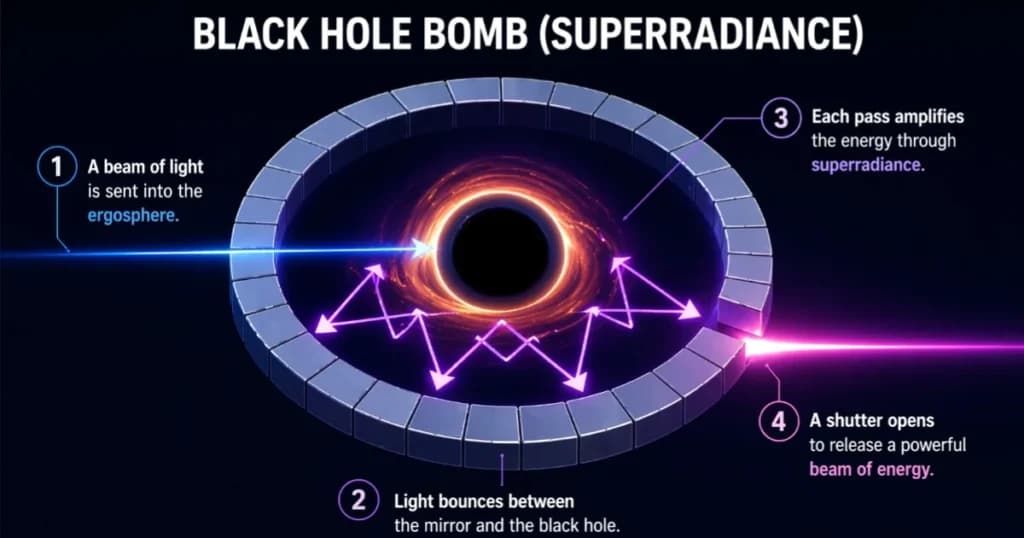
Eventually, you open a small shutter in the mirror to let out a concentrated beam of power. This isn’t just a fantasy; it’s a logical step for a Type III civilization on the Kardashev scale. Concepts like this fall under the broader idea of alien astroengineering, where advanced civilizations manipulate cosmic structures for energy. If you can control a black hole, you have a power source that lasts for billions of years. It’s the ultimate sustainable energy.
I’ve often thought that if we ever find “anomalous” flashes near distant black holes, we might be seeing an alien power plant at work. In fact, some physicists have suggested that unusual, highly energetic emissions near black holes could one day be analyzed as potential techno-signatures.
How Much Energy Could the Penrose Process Give?
The efficiency here is staggering. For a stationary black hole, you get zero. But for a black hole spinning at its maximum theoretical limit, you can extract up to 29% of its total mass-energy. To put that in perspective, nuclear fusion (the power of our sun) only converts about 0.7% of its mass into energy.
The Penrose Process is dozens of times more efficient than any star in the sky. It would turn a single black hole into a battery capable of powering entire galaxies. For comparison, even the most advanced human energy systems barely scratch a fraction of this efficiency. This maximum efficiency depends on the black hole spinning near its theoretical limit, known as an extremal Kerr black hole.
Why the Penrose Process Changes the Future of Cosmic Energy
As the universe gets older, stars will burn out and galaxies will drift apart. Most life will face a dark, cold end. But the Penrose Process gives us a lifeline. Black holes are the most durable objects in existence. Some extreme environments, like binary black hole systems, could make these energy processes even more complex and fascinating. They’ll survive long after the last sun goes dark.
By harvesting rotational energy, a civilization could survive in the deep future by turning their home black hole into a campfire. It shifts our perspective from fearing black holes to seeing them as the ultimate cosmic inheritance. In a universe heading toward heat death, this kind of energy extraction could be one of the last remaining ways to sustain complex life.
In short: The Penrose Process allows energy extraction from a spinning black hole by exploiting the strange physics of its ergosphere, making it one of the most efficient energy mechanisms in the universe.
FAQs About Extracting Energy from Black Holes (Penrose Process)
Below are some of the most common questions people ask about the Penrose Process and black hole energy extraction.
What is the ergosphere of a black hole?
The ergosphere is a region outside a rotating black hole where space-time is dragged along with its rotation. It allows objects to gain energy and escape, making processes like the Penrose Process possible.
Can a black hole be used as an energy source?
Yes, but only if it’s spinning. A rotating black hole stores energy in its ergosphere. We can use the Penrose Process to harvest this rotational energy and convert it into usable power.
What’s the Penrose Process in simple terms?
It’s like throwing a ball into a whirlpool and having two balls come back out, but one is moving much faster. You trade a bit of the black hole’s spin for a massive boost in energy.
Is extracting energy from a black hole possible?
The laws of physics say yes. There’s no law of thermodynamics that forbids it. The main challenge is the engineering required to operate near an event horizon without being destroyed.
How efficient is the Penrose Process?
It’s incredibly efficient, reaching up to 29%. This makes it much more powerful than solar energy or nuclear fusion. It’s the most efficient known way to turn mass into energy in the universe.
Could humans ever use black holes for power?
Not with today’s technology. We’d need to be able to reach a black hole first. Current rockets don’t have the speed or the radiation shielding needed to get us close enough to test the Penrose Process.
Conclusion: The Future of Black Hole Energy
Stealing energy from the most powerful objects in the universe isn’t just a dream for physicists. The Penrose Process proves that the vacuum of space is filled with potential, and black holes aren’t just traps; they’re the ultimate engines. While we won’t be building a black hole mirror this century, the math stays the same. The energy is there, waiting for anyone brave enough to go and take it. And if any civilization ever masters this process, they wouldn’t just survive the universe, they would outlive the stars themselves. It’s the closest thing to a “free lunch” the universe has to offer.

Aman Mathur
Founder of Stellar Illusion and astronomy writer with a focus on astrophysics and space science.