Swipe to Discover
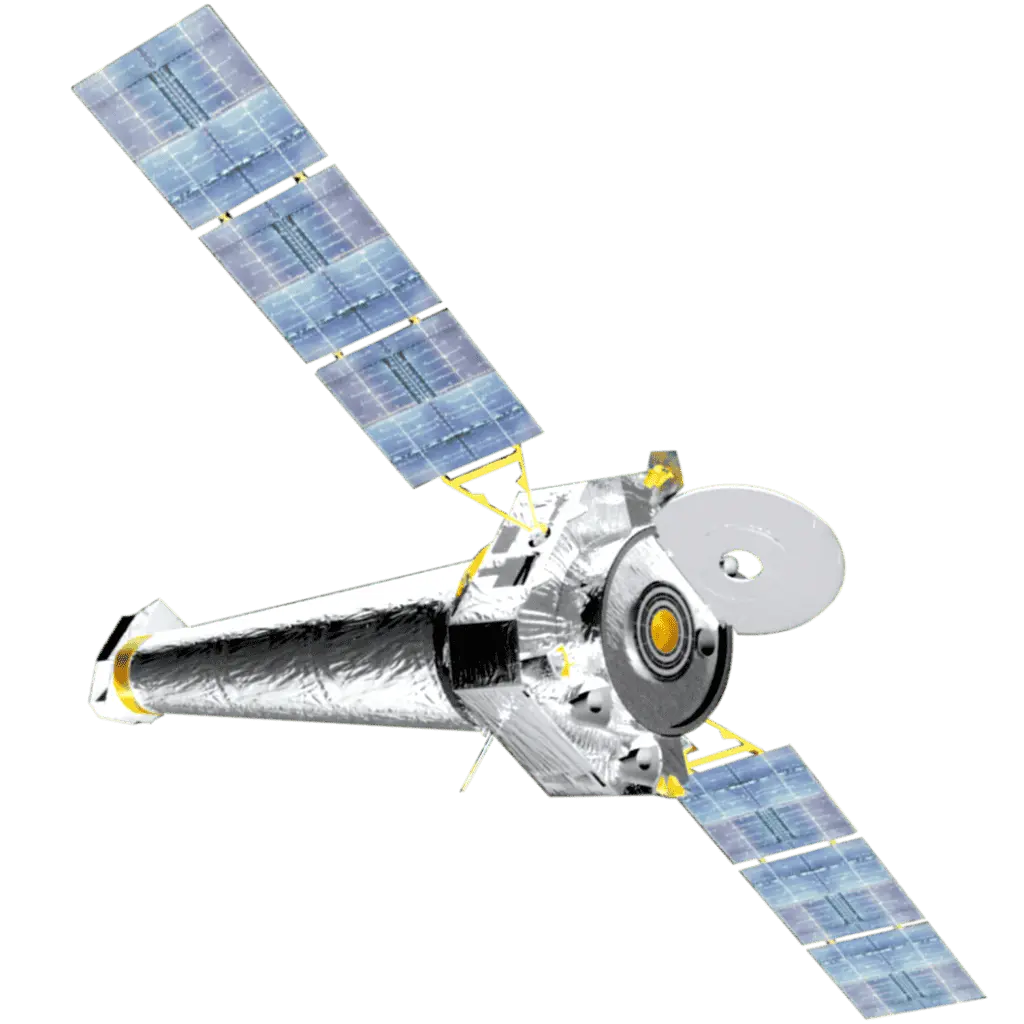
“Chandra can detect X-rays from objects billions of light-years away!”
Observing the Cosmos Beyond Atmospheric Limits
For centuries, astronomers were limited to ground-based observations. The Earth's atmosphere, while shielding us from cosmic radiation, acts as a turbulent filter that distorts incoming light. Placing telescopes in orbit changed everything, allowing instruments to capture crisp images and gather details across wavelengths that cannot reach the ground. Space-based observatories operate continuously, observing deep-space targets without the interference of day-night cycles or light pollution.
The Spectrum of Discovery
Different cosmic structures emit energy in different parts of the electromagnetic spectrum. The Hubble Space Telescope focuses primarily on visible and ultraviolet light, capturing detailed structures of stars and nebulae. In contrast, the James Webb Space Telescope operates in the infrared spectrum, letting it peer through dense interstellar dust clouds to capture light from the very first galaxies. Observing in infrared also reveals cooler cosmic objects, such as forming planets and brown dwarfs, which remain invisible to optical sensors.
High-Energy Observatories
Extreme cosmic events like black holes, exploding supernovae, and neutron star collisions do not emit optical light. Instead, they release high-energy X-rays and gamma rays. Instruments like the Chandra X-ray Observatory target these violent events, providing essential data about superheated matter orbiting the event horizons of black holes. By combining datasets from visible, infrared, and X-ray telescopes, astronomers can construct complete models of how stars live, die, and influence their host galaxies.
Comparing Mission Architecture
Building and deploying a space telescope is one of the most complex engineering challenges in space science. The database in this explorer compares key specifications of historic and current missions, including telescope mirror dimensions, orbit types, launch dates, and mission budgets. Understanding these parameters highlights the progress of telescope design, showing how mirror size and orbit selections (such as the Lagrange L2 point) directly determine the depth and clarity of our cosmic views.