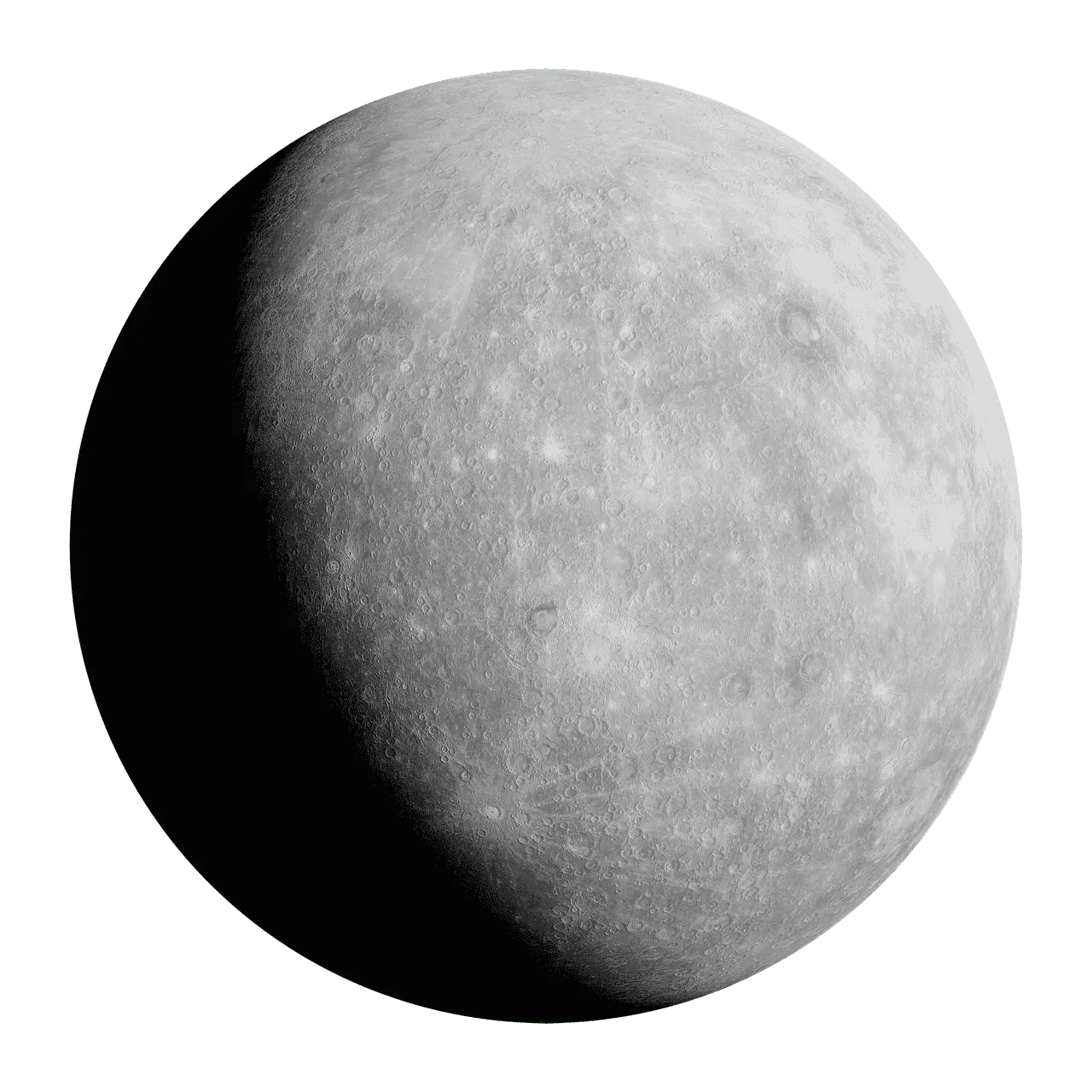
“Mercury has no atmosphere, so there's no weather - no wind, no clouds, no rain or snow!”
Understanding Our Planetary Neighborhood
The solar system is a vast and dynamically active place. It is divided into distinct zones, each defined by the materials that could solidify close to the early Sun. Near the center, where temperatures were high, only rock and metal could remain solid. This led to the formation of the four terrestrial planets. Further out, beyond the frost line, water, ammonia, and methane froze into ice, allowing massive gas giants to accumulate thick hydrogen and helium atmospheres. Studying these celestial bodies helps astronomers piece together how stellar systems form and evolve across the galaxy.
The Inner Rocky Planets
Mercury, Venus, Earth, and Mars represent the inner solar system. These worlds are characterized by solid surfaces, metallic cores, and volcanic histories. Mercury is a cratered remnant with almost no atmosphere, experiencing extreme temperature shifts. Venus is wrapped in a runaway greenhouse effect, creating surface conditions hot enough to melt lead. Earth sits in the habitable zone, holding liquid water and a rich biosphere, while Mars remains a cold desert with evidence of ancient lakes and rivers that once flowed across its red soil.
The Outer Gas Giants
Beyond the asteroid belt lie Jupiter, Saturn, Uranus, and Neptune. Jupiter is the largest planet in our system, holding more mass than all other planets combined. Its massive gravity shapes the orbits of nearby bodies and protects the inner system from outer comets. Saturn is famous for its intricate ring system, composed of ice particles and rock fragments. Uranus and Neptune are ice giants, with deep atmospheres rich in water, ammonia, and methane, giving them their characteristic blue and green colors.
Why Comparative Data Matters
By examining variables like planetary radius, gravitational density, day length, and orbital periods, scientists can model the interior structures of other worlds. The differences in planetary stats are not random. They tell the story of collision histories, solar wind stripping, and orbital migration. The database presented in this explorer lists verified metrics from space agency missions, providing a quick comparison of how gravity, mass, and time behave across our solar system.