In practice, tracking the inner solar system feels like chasing a ghost. I’ve spent many cold mornings tracking the horizon just to catch a five-minute glimpse of this elusive world. Put simply, the Mercury planet sits so close to our sun that it’s often lost in the glare. Beyond this, it’s a tiny, iron-heavy rock that defies basic planetary logic, and you won’t find a moon here, nor a thick atmosphere to trap heat. As a result, it’s a world of scorched plains and frozen shadows.
Overview of Mercury Planet
Worth noting: small and stubborn, Mercury is barely larger than Earth’s moon. It orbits our star at an average distance of 36 million miles. This proximity makes it the fastest planet in the neighborhood, zipping through space at 29 miles per second. Astronomers call it a terrestrial planet because of its rocky surface. It’s built like a cannonball, mostly comprised of metal. Since it lacks a thick blanket of air, the world is quiet and battered by billions of years of space debris.
Formation and Evolution of Mercury
About 4.5 billion years ago, a swirling disk of gas and dust birthed the inner planets. Mercury took shape in the hottest region of this disk, which likely prevented light gases and ice from sticking. Most scientists believe a massive impact early in its life changed everything. A giant object probably smashed into the young world, stripping away most of its outer rocky shell. This event left behind the oversized core we see today, turning the planet into a metallic heavy-weight.
Structure and Composition of Mercury
This tiny world is dense because it holds a massive secret, and mercury’s metallic core takes up about 85% of the planet’s total radius. For comparison, Earth’s core only occupies about half of its internal space. The core isn’t just solid rock: scientists think it’s partly liquid. This molten heart generates a weak but stable magnetic field that protects the surface from some solar radiation.
Surrounding that massive core is a thin layer of rock called the mantle and a dusty outer crust. Observations from NASA’s MESSENGER Mission showed that the crust contains weirdly high levels of sulfur and potassium. These chemicals usually boil away easily near the sun. Finding them there means our old theories about how planets form might need a total overhaul. It shouldn’t be this chemical-heavy, yet it’s full of surprises.
Rotation, Orbit, and Temperature Extremes
Mercury has a weird relationship with the sun, and it doesn’t spin perfectly upright: it’s almost straight up and down. One day on Mercury lasts a long time because the planet spins very slowly. It takes 59 Earth days to complete one rotation. But it only takes 88 Earth days to complete a trip around the sun. This means if you stood on the surface, you’d wait 176 Earth days between one sunrise and the next.
This slow rotation leads to the most violent temperature swings in the solar system. During the day, the ground reaches a blistering 800 degrees Fahrenheit, and that’s hot enough to melt lead. At night, with no atmosphere to hold the heat, it drops to minus 290 degrees. One side of the planet is a furnace while the other is a deep freezer. It’s a world of absolute, bone-chilling opposites.
Surface Features of Mercury
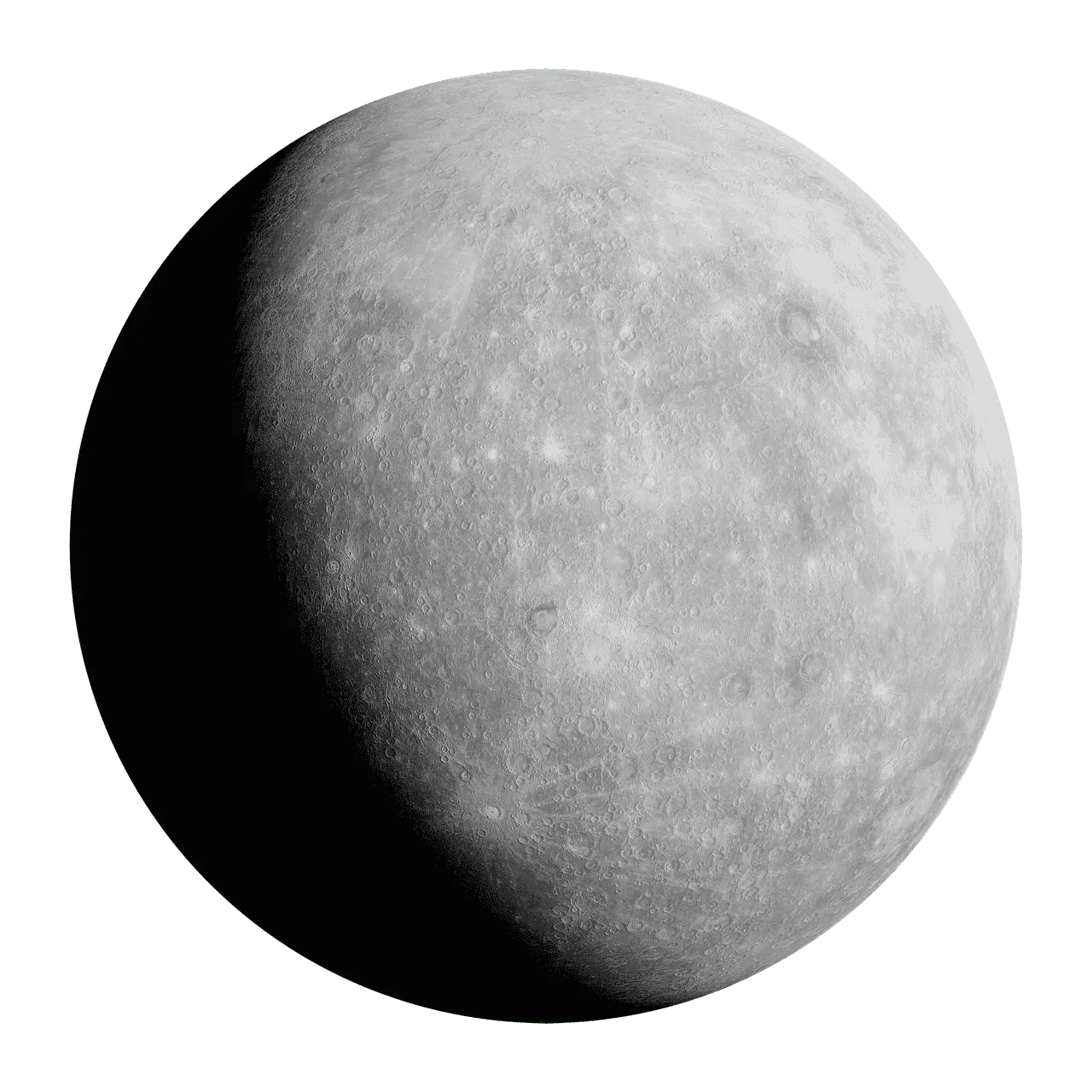
Look at a photo of Mercury and you might think you’re seeing our moon. It’s covered in thousands of impact craters from ancient asteroids, and you’ll see massive basins like Caloris, which spans 960 miles across. Large cliffs called ‘lobate scarps’ zig-zag across the surface like giant wrinkles. Geologists think these formed because the planet’s core cooled down and shrank. The planet literally wrinkled as it grew smaller, pushing the crust upward.
Exosphere and Magnetic Field
You can’t breathe the air on Mercury because it doesn’t have a true atmosphere. Instead, it has a thin ‘exosphere’ made of atoms blasted off the surface by solar wind. This layer contains oxygen, sodium, hydrogen, helium, and potassium, and it’s so thin that these atoms rarely even bump into each other. Still, the planet’s magnetic field manages to trap some of this gas. It’s only 1% as strong as Earth’s field, but it’s enough to create ‘magnetic tornadoes’ on the surface.
How Mercury Compares to Other Planets
While Earth is full of water and life, Mercury is a dry, barren wasteland. It’s smaller than the largest moons of Jupiter and Saturn, though it’s much heavier due to its iron content. Venus is actually hotter than Mercury because Venus has a thick greenhouse atmosphere that traps heat. Mercury is the ‘runaway’ child of the system. It stays close to the sun, moves faster than its siblings, and lacks the air and moons they possess.
Key Facts and Figures
- Diameter: 3,032 miles.
- Surface Gravity: 37% of Earth’s gravity.
- Moons: Zero.
- Rings: None.
- Year Length: 88 Earth days.
- Day Length: 58.6 Earth days per rotation.
- Density: 5.43 grams per cubic centimeter.
Exploration and Latest Discoveries
Humans haven’t sent many probes to this sun-scorched rock. Only two missions have visited Mercury up close. Mariner 10 flew by in the 1970s, but MESSENGER was the first to actually stay in orbit. Recently, scientists discovered that ice exists at Mercury’s poles. It hides in the bottom of deep craters where the sun never shines. How can ice exist on a planet that’s 800 degrees, and the shadows are the key. If you stay in the dark, the cold is permanent.
Why Mercury Matters
Mercury tells us about the early history of every rocky planet. Since it doesn’t have wind, rain, or plate tectonics, its surface preserves a billion-year-old record. Studying its core helps us understand how magnetic fields work. It acts like a laboratory for extreme physics. If we can understand why this planet is so metallic and weird, we might find out how the Earth itself began.
FAQs about Mercury Planet
-
Can we live on the Mercury planet?
Living there isn’t possible with current tech. The extreme heat, lack of air, and high radiation levels would kill a human instantly.
-
Why is Mercury so small?
Many researchers believe a massive collision in the past blew away most of its original outer layers. It left behind only the dense core.
-
Does it ever rain on Mercury?
No. There’s no water cycle or thick atmosphere to support clouds or rain. The surface is extremely dry.
-
Is Mercury hotter than Venus?
Mercury isn’t the hottest. Venus is hotter because its thick carbon dioxide clouds trap heat, making it a constant 900 degrees.
-
How many moons does it have?
Mercury has zero moons. Its gravity is likely too weak to hold onto a moon so close to the sun’s massive pull.
Final Thoughts
The Mercury planet remains one of the most mysterious places in our sky. It’s a world of contradictions: fire and ice, metal and dust, speed and slow rotation. We’ve barely scratched the surface of what it has to teach us, and new missions like BepiColombo are already on their way to unlock more secrets. Every new data point proves that even the smallest planet has a big story to tell.