Think about the farthest reaches of our neighborhood. Most people imagine a dark, empty void. But that’s where you’ll find Pluto: The Dwarf Planet of the Kuiper Belt, a world that refuses to be ignored. It’s a place where nitrogen behaves like glaciers and mountains of water ice tower miles into a thin, hazy sky. For decades, we thought of it as a lonely ninth planet. Now, we know it’s the gateway to a massive ring of icy objects. It’s smaller than our Moon, but its story is much bigger than its size suggests.
Overview of Pluto: The Dwarf Planet of the Kuiper Belt
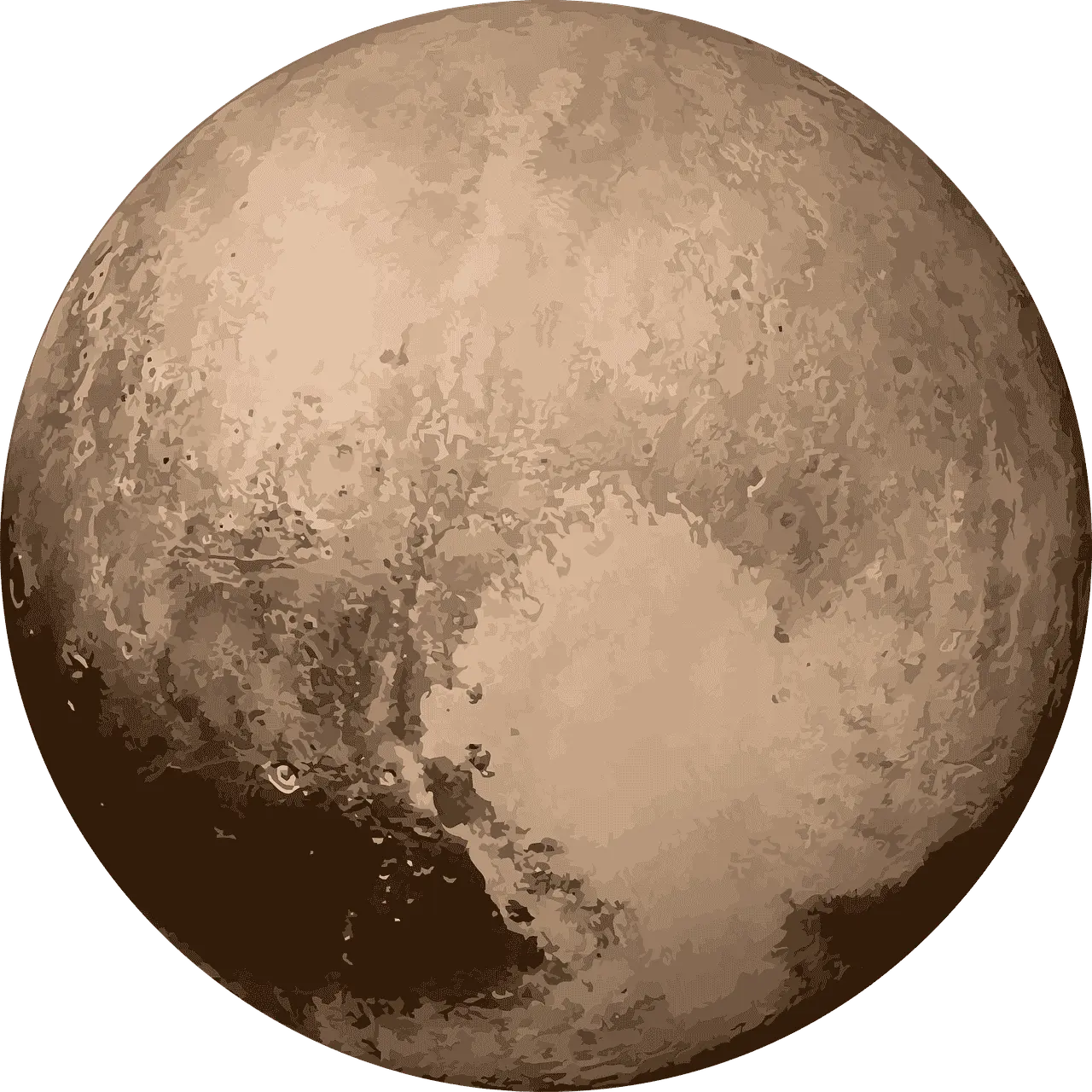
Pluto sits roughly 3.7 billion miles from the sun on average. It’s the largest known resident of the Kuiper Belt, a vast donut-shaped region of icy debris beyond Neptune. When I first looked at the 2015 imaging data, I couldn’t believe how complex it was. People expected a boring cratered rock. Instead, they got a lively world with bright ‘heart-shaped’ plains and dark, ancient craters. It has five moons of its own, with Charon being so large they almost orbit each other like a double planet system. It’s a weird, wild place that keeps rewriting the science books.
Formation and Evolution of Pluto: The Dwarf Planet of the Kuiper Belt
This tiny world didn’t just appear out of nowhere. It formed about 4.5 billion years ago. Back then, the solar system was a spinning disk of gas and dust. Pluto began as a small seed, pulling in nearby ice and rock through gravity. This process, called accretion, was slow in the outer reaches of the system. Because everything is so spread out in the Kuiper Belt, Pluto didn’t have enough ‘building material’ to grow into a gas giant like Jupiter or Neptune.
The evolution of this world is still happening today, and its path through space changed over eons as the giant planets migrated. Scientists think Neptune’s gravity actually pushed Pluto further out into its current tilted orbit. This gravitational dance trapped it in a specific rhythm. For every three times Neptune goes around the sun, Pluto goes around twice. This resonance keeps them from ever crashing into each other, even though their paths cross. It’s a stable, ancient balance that has lasted for billions of years.
Structure and Composition of Pluto: The Dwarf Planet of the Kuiper Belt
If you could slice Pluto in half, you wouldn’t find a simple ball of ice. It’s got layers, much like a giant onion. At the center sits a rocky core that takes up about 70 percent of its mass. This rock probably contains radioactive elements that generated heat early on. Scientists now suspect that this heat could have melted enough ice to create a liquid water ocean between the core and the outer icy shell.
I’ve followed the research on its mantle closely. The shell above the core is mostly made of water ice. On top of that sits a thin crust of exotic frosts like nitrogen, methane, and carbon monoxide. These aren’t the kind of ice cubes you’d find in your freezer. They’re ‘soft’ ices that flow under the planet’s weak gravity. This soft ice is why the surface looks so young in some places, it’s constantly being recycled by internal forces we’re still trying to fully grasp.
Rotation, Orbit, and Temperature Extremes of Pluto: The Dwarf Planet of the Kuiper Belt
Pluto doesn’t act like the other planets. While most planets orbit the sun in nearly perfect circles on a flat plane, Pluto is different. Its orbit is shaped like a long, stretched-out oval. This means it gets as close as 2.7 billion miles and as far as 4.5 billion miles from the sun. During its ‘close’ approach, it’s actually closer to us than Neptune is. This happened last between 1979 and 1999. It’s like a cosmic guest that occasionally cuts in line.
The temperature on this world is brutal. It ranges from minus 375 to minus 400 degrees Fahrenheit. If you stepped outside there, you’d be frozen solid in a split second. A day on Pluto lasts about 6.4 Earth days. Because the planet is tipped on its side, the seasons are extreme. Some parts of the surface stay in total darkness for decades while other parts are bathed in constant, weak sunlight. It’s a slow-motion cycle of freezing and slightly less-freezing weather.
Surface Features of Pluto
When the New Horizons spacecraft flew by, we saw things nobody could’ve predicted. The most famous feature is Sputnik Planitia. It’s a massive basin shaped like a heart, and it’s filled with nitrogen ice. It acts like a giant glacier. Deep beneath this heart, there might be currents that slowly push new ice to the surface. It looks remarkably smooth, which means it’s very young, maybe less than 100 million years old.
Away from the heart, you’ll find dark, reddish terrains. This color comes from tholins, which are complex organic molecules formed when sunlight hits methane and nitrogen. There are also mountains made of solid water ice. At these temperatures, water ice is as hard as rock. Some of these peaks are as tall as the Rockies, and you also have ‘ice volcanoes’ or cryovolcanoes. Instead of lava, they spew a slushy mix of water and ammonia. This proves that even though it’s small, it isn’t dead inside.
Exosphere and Magnetic Field
Pluto has a very thin atmosphere, technically called an exosphere. It’s mostly nitrogen, just like Earth’s air, but it’s millions of times thinner. When it’s closer to the sun, the ice on the surface turns into gas. This creates a hazy blue atmosphere that can extend high into space. I remember seeing the pictures of the blue ring around Pluto; it looked hauntingly similar to Earth from a distance.
But this air is fragile. As it moves away from the sun and gets colder, the atmosphere freezes and falls to the ground like snow. Regarding a magnetic field, Pluto doesn’t seem to have its own. This means the solar wind, charged particles from the sun, hits the atmosphere directly. It slowly strips away the gas and blows it into space, creating a long tail of ions behind the planet. It’s essentially ‘bleeding’ its atmosphere into the void every day.
How Pluto Compares to Other Planets
It’s hard to wrap your head around how small Pluto actually is. If you put Earth side-by-side with it, Pluto would look like a tiny marble next to a basketball. It’s only about 1,400 miles wide. That’s narrower than the United States. In fact, if you drove from New York to California, you’d have traveled further than the entire diameter of the dwarf planet.
Unlike the rocky planets (like Earth) or the gas giants (like Jupiter), Pluto is an ‘ice dwarf.’ Its gravity is weak, only about 7 percent of Earth’s. You could jump incredibly high there, and everything would feel light. Also, its moons are huge relative to its size, and charon is half as wide as Pluto. This makes their center of gravity exist in the space between them. They don’t just orbit a point; they dance around each other. No other planet in our system has a moon relationship quite like this one.
Key Facts about Pluto: The Dwarf Planet of the Kuiper Belt
Type: Dwarf Planet
Radius: 738 miles (1,188 km)
Year length:248 Earth years
Moons: 5 (Charon, Styx, Nix, Kerberos, Hydra)
Average Distance from Sun:3.7 billion miles
Surface Gravity:0.62 m/s²
Discovery: 1930 by Clyde Tombaugh
Exploration and Latest Discoveries
For most of history, Pluto was just a blurry dot in our telescopes. That changed in July 2015. The New Horizons mission zipped past at 30,000 miles per hour. It sent back data that took over a year to fully download. I’ve spent hours looking at those high-res maps. They showed us that the ‘Pluto heart’ is actually a massive convecting cell of ice.
Recent studies of the 2015 data suggest something even crazier. There are signs of ‘spider’ fractures on the surface. These cracks look like the planet expanded from the inside. This happens when an internal ocean starts to freeze and push outward. If there’s still liquid water there today, it might be kept warm by the friction of Charon’s gravity or leftover heat in the core. It’s a prime candidate for studying how life-sustaining ingredients could exist in the farthest reaches of space.
Why Pluto Matters
Pluto is the sentinel of the Kuiper Belt. It’s our best window into the ‘scrap heap’ of the solar system’s creation. By studying it, we learn about the original chemistry of our sun’s nursery. It also taught us that ‘small’ doesn’t mean ‘simple.’ Before we visited, many experts thought small frozen worlds would be inactive. Pluto proved them wrong. It showed that geology can thrive even in the deepest freeze.
Understanding this dwarf planet helps us categorize the thousands of other objects out there, and eris, Makemake, and Haumea are all icy worlds like Pluto. If we want to understand our place in the galaxy, we have to look at the edge. It’s a reminder that the solar system doesn’t just stop after Neptune. It keeps going, full of surprises and frozen mysteries that we’ve barely begun to solve.
FAQs about Pluto
-
Why is Pluto no longer a planet?
In 2006, the International Astronomical Union set new rules. A planet must orbit the sun, be round, and ‘clear its neighborhood’ of other junk. Because Pluto orbits inside the crowded Kuiper Belt, it failed the third rule. So, they called it a dwarf planet instead.
-
Can humans breathe the air on Pluto?
No. Even though it has nitrogen like Earth, it’s way too thin. There’s almost no oxygen. Plus, the pressure is so low your blood would boil if you weren’t in a pressurized suit. It’s a vacuum compared to what we need.
-
Is it always dark on Pluto?
Not exactly. At high noon on Pluto, it’s about as bright as a gloomy day at dusk on Earth. You could still see your surroundings and even read a book, but you wouldn’t want to forget your flashlight if you went for a walk.
-
How many moons does Pluto have?
Pluto has five moons. Charon is the big one. Then there are four tiny ones: Nix, Hydra, Kerberos, and Styx. These smaller moons are jagged and irregularly shaped, likely leftovers from a massive collision long ago.
-
Could there be life on Pluto?
It’s unlikely but not impossible. Surface life is a ‘no’ because of the cold. But, if there’s a liquid ocean deep underground, some scientists think simple microbes could exist. We won’t know for sure until we send a probe that can land and dig.
Final Thoughts
Pluto: The Dwarf Planet of the Kuiper Belt is more than just a label. It’s a complex, active world that challenged our view of the universe. It’s not just a rock at the end of the line; it’s the beginning of a whole new frontier. As we look deeper into the Kuiper Belt, we keep finding more reasons to appreciate this icy heart in the dark. Don’t let its size fool you, it’s a giant of the outer solar system.