5 Key Facts About Star Formation Process Explained
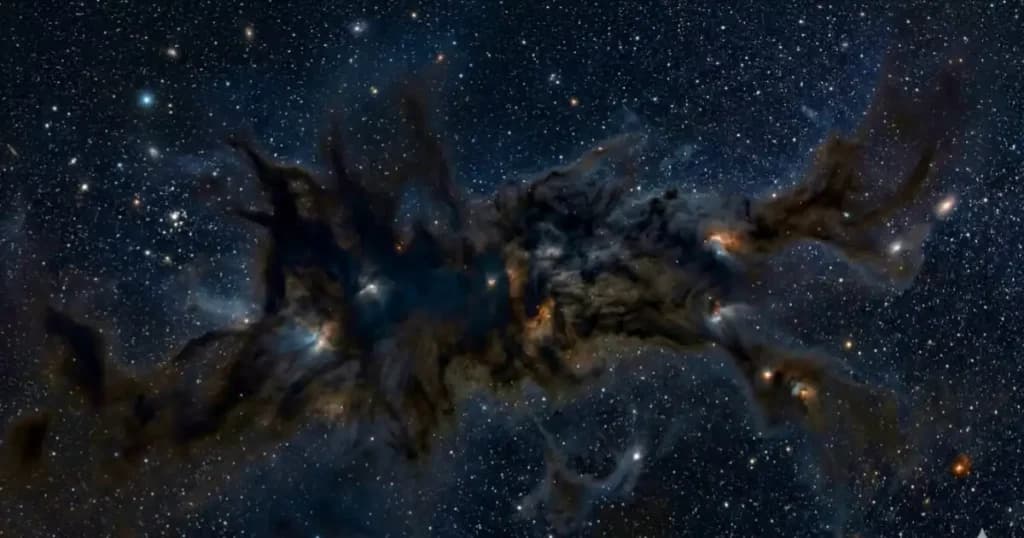
A cold molecular cloud, the starting point of star formation where gravity slowly pulls gas into dense regions.
Tags:
- Axion Stars
- Star Formation
Stars don’t just exist. They’re born, they live, and eventually they die. The Star Formation process is one of the most fundamental cycles in the universe, and honestly, it’s one of the most beautiful things astrophysics has to offer.
I find it strange that most people never question where stars come from. We look up at night, see them scattered across the night sky, and accept them as fixtures. They aren’t. Roughly three new stars form in our galaxy every single year, according to estimates from NASA’s Hubble Space Telescope observations. Right now, somewhere in the Milky Way, a cloud of gas is collapsing under its own gravity.
The Anatomy of a Stellar Nursery
Everything starts with molecular clouds. These are enormous regions of cold gas and dust, sometimes spanning hundreds of light-years across, scattered throughout Galaxies. They’re composed mostly of molecular Hydrogen, with some Helium and trace amounts of heavier elements. Astronomers call them Stellar Nurseries, which is a bit romantic but not inaccurate.
The problem with molecular clouds is that you can’t see them in visible light. They’re too cold to emit much radiation. Radio telescopes like The Atacama Large Millimeter Array in Chile have revolutionized our ability to map these structures by detecting emissions from carbon monoxide molecules embedded within them.
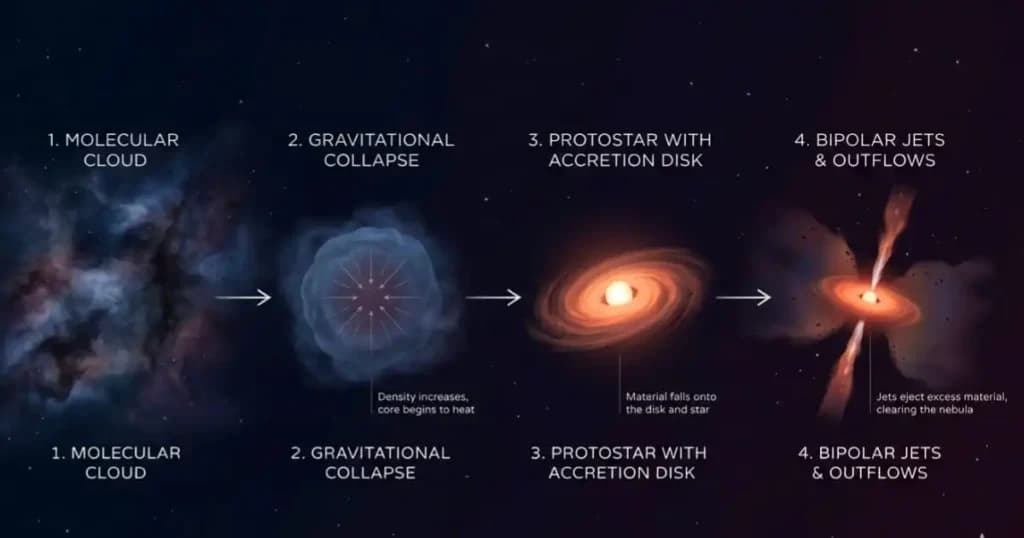
Inside these clouds, certain regions grow denser than their surroundings. When a dense pocket of gas reaches a critical mass relative to its temperature and density, gravity wins. The gas collapses.
The Jeans Mass Threshold
Here’s where the physics gets interesting. In 1902, British physicist James Jeans worked out the mathematical conditions under which a cloud of gas will begin to collapse under its own gravity. The result is elegant and still used today.
The Jeans Mass depends on Temperature, Density, and Fundamental constants. Cold, dense gas needs less mass to collapse. Hot, diffuse gas needs significantly more. This matters because it predicts where and when star formation should occur. A molecular cloud core at about 10 Kelvin with a density around 10,000 particles per cubic centimeter will have a Jeans mass of roughly one Solar Mass. That’s not a coincidence. Nature has a preferred scale.
From Collapse To Protostar
Once a gas cloud crosses the Jeans Threshold, the collapse accelerates. But it doesn’t contract uniformly. The cloud fragments into smaller clumps, each one potentially becoming an individual star. This fragmentation is why stars tend to form in clusters rather than alone. The Orion Nebula, roughly 1,350 light-years away, contains over 700 young stars at various stages of formation, many born from the same parent cloud.
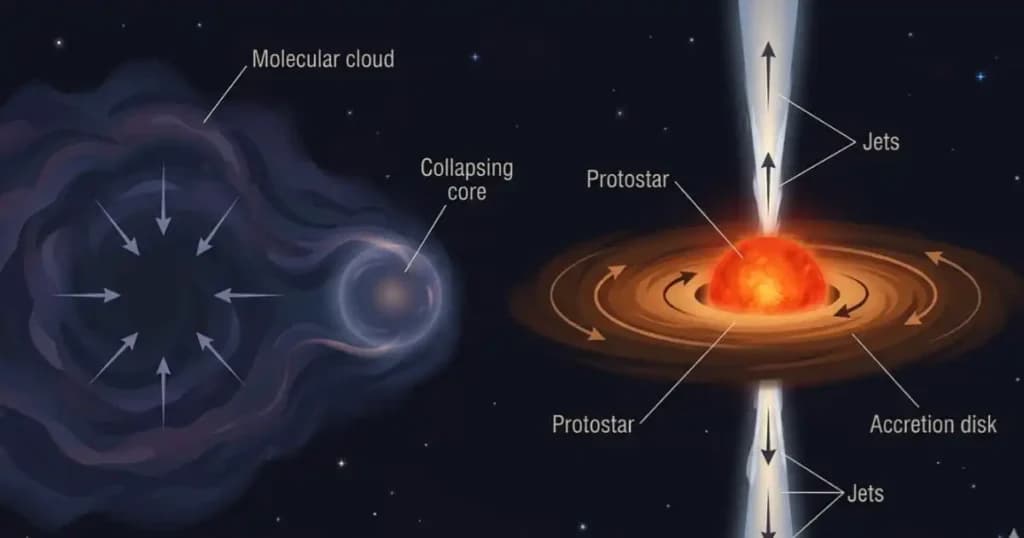
As material falls inward, conservation of angular momentum spins the collapsing cloud faster. This rotation flattens the infalling gas into a disk surrounding a central Protostar. We’ve directly observed these protoplanetary disks around young stars like HL Tauri, captured in stunning detail by ALMA in 2014.
During this phase, powerful jets of gas shoot out from the poles of the young stellar object. These bipolar outflows are driven by magnetic fields threading through the rotating accretion disk. They carry away angular momentum, allowing material to continue falling onto the growing protostar.
The Ignition Of Nuclear Fusion
The moment a protostar becomes a true star is when core temperatures reach approximately 10 million Kelvin. At that threshold, Hydrogen Nuclei begin fusing into Helium through the proton-proton chain reaction. The energy released creates an outward radiation pressure that exactly balances the inward pull of gravity. That balance is called Hydrostatic Equilibrium, and it defines the main sequence of stellar evolution.
The mass of the resulting star determines everything. More massive stars burn hotter and brighter but exhaust their fuel far faster. A star 10 times the mass of the Sun will live roughly 1,000 times shorter, despite having only 10 times the fuel. That tradeoff between mass and lifespan is one of the most counterintuitive results in Astrophysics.
What Modern Observations Reveal About Star Formation
The James Webb Space Telescope, operational since 2021, has transformed our view of star formation. Its infrared capabilities peer through dust clouds that block visible light entirely. Webb has revealed protostars embedded in their natal clouds with unprecedented clarity, showing us structures we simply couldn’t detect before.
What strikes me most is how much we still don’t fully understand. The details of fragmentation, how magnetic fields and turbulence compete with gravity, whether planets form alongside their host stars in most cases, these questions remain genuinely open.
The star formation process is physics in its most elemental form. Gravity pulls matter together until nuclear fire ignites. Simple in principle, endlessly complex in practice, and responsible for every atom heavier than lithium in your body. That’s worth thinking about the next time you look up at the night sky.
5 Key Facts About Star Formation
Before wrapping this up, here are the five things that are worth keeping in mind. They sound simple on the surface, but each one sits on top of some fairly deep physics.
- Star formation begins in cold, dense molecular clouds where gravity slowly gains the upper hand over internal pressure.
- The Jeans Mass sets the tipping point. If a region crosses it, collapse is no longer optional. It is inevitable.
- Stars almost never form in isolation. Fragmentation ensures that most of them are born in clusters, sharing a common origin.
- A protostar only becomes a true star when nuclear fusion ignites in its core, locking it into Hydrostatic Equilibrium.
- Even with Telescopes like Webb, the finer details are still unresolved. Star formation is understood in principle, but messy in reality.
FAQs Regarding Star Formation
- What triggers star formation in the first place?
- Star formation begins when regions inside molecular clouds become dense enough for gravity to take over. External factors like shock waves from supernovae or galactic interactions can also compress gas and kickstart the collapse.
- Why do stars usually form in clusters instead of alone?
- As a molecular cloud collapses, it fragments into multiple dense clumps. Each clump can form a star, which is why we often see stars born together in clusters rather than in isolation.
- What determines the mass of a star?
- The amount of material available in the collapsing region largely sets the final mass. Local conditions like temperature, turbulence, and magnetic fields also influence how much matter the protostar can gather.
- How long does it take for a star to form?
- Star formation is not instant. It typically takes a few hundred thousand to a few million years for a collapsing cloud to evolve into a fully formed star with active nuclear fusion.
- Do all stars form planetary systems?
- Not all, but many do. The rotating disks around young protostars often contain enough material to form planets, though the exact outcome depends on the disk’s mass and stability.

Vinay Sharma
Contributor at Stellar Illusion with a keen interest in cosmology, planetary science, and the latest developments in space exploration.