Imagine looking at a crowd of people. You see their faces and hear the noise, but you don’t know where they’re heading. The Imaging X-ray Polarimetry Explorer acts like a compass for starlight, showing us the hidden directions of cosmic particles. Since its 2021 launch, this mission’s redefined how we see high-energy space. It doesn’t just catch light: it measures the vibration angle, revealing the invisible magnetic cages that trap matter near black holes. This satellite remains our best tool for understanding the violent, magnetic skeleton of the universe today.
What’s Imaging X-ray Polarimetry Explorer?
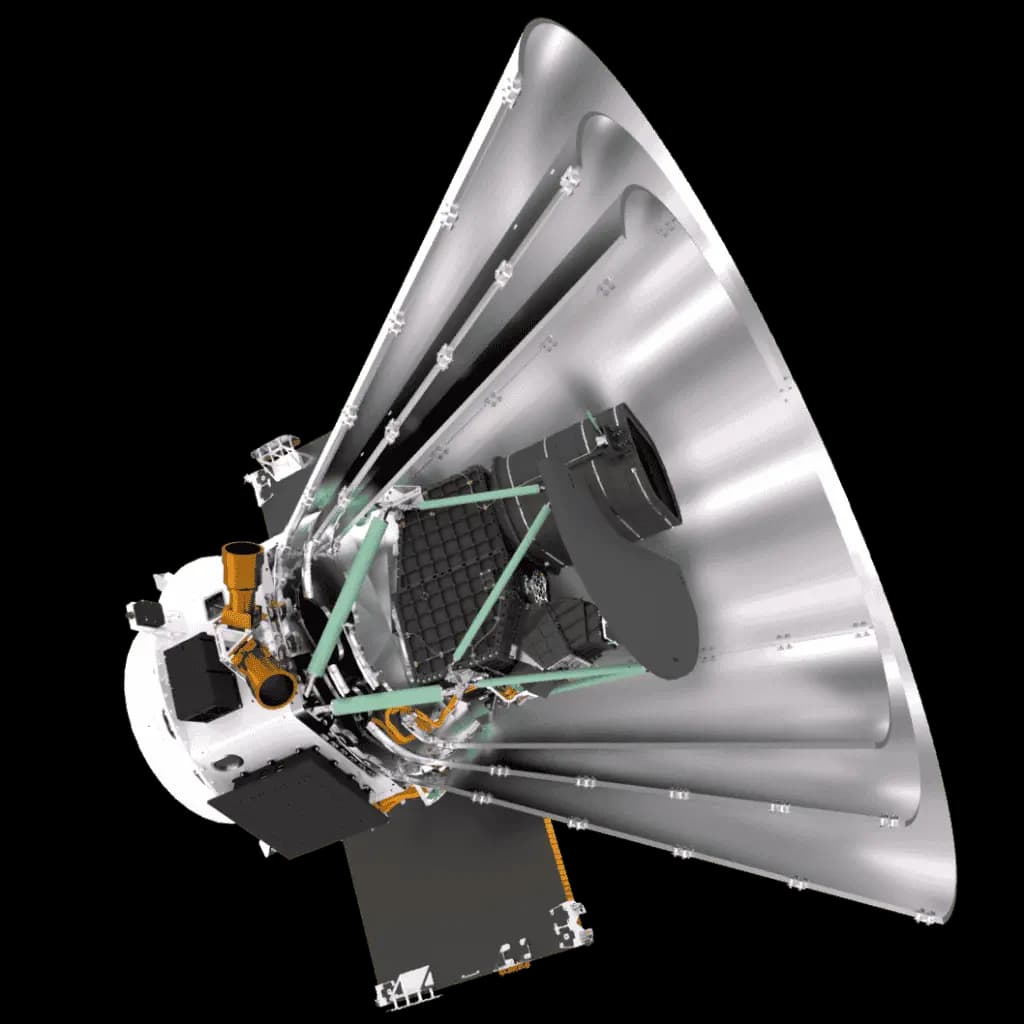
NASA joined forces with the Italian Space Agency to launch this unique observer in December 2021. It orbits roughly 370 miles above Earth in a low-equatorial path, which keeps it away from harsh radiation belts. Scientists categorize it as a ‘Small Explorer’ mission, yet its impact punches far above its weight class. It’s essentially a set of three identical telescopes that focus on X-ray ‘polarization,’ a property of light that tells us about the environment where that light was born.
Purpose and Mission Objectives (Why It Was Built)
The primary goal was to study the orientation of light waves from extreme sources. While previous telescopes measured how bright an object was or what ‘color’ its X-rays were, they couldn’t see the direction.
- Map magnetic fields: Trace the invisible lines around pulsars and supernova remnants.
- Test General Relativity: See how gravity twists light near a black hole’s edge.
- Study particle acceleration: Figure out how jets of matter reach near-light speeds.
- Investigate Magnetars: Explore neutron stars with magnets a trillion times stronger than Earth’s.
Key Discoveries of Imaging X-ray Polarimetry Explorer
The mission first shocked the world by mapping the magnetic field of Cassiopeia A. We used to think these supernova remains were a tangled mess. IXPE data showed surprisingly ordered magnetic loops that act like particle accelerators. I recall the internal buzz when the 2023 maps revealed these fields weren’t random. They formed neat, circular patterns that forced us to rewrite our textbooks on how stars explode.
Another massive win came from observing the ‘Godzilla’ of black holes at the center of our galaxy. Researchers found evidence that Sagittarius A* wasn’t always this quiet, and iXPE detected an ‘X-ray echo’ from a massive flare that happened 200 years ago. This discovery proved our galaxy’s core was once a million times brighter. It showed that even dormant giants have a history of waking up and screaming into the void.
Finally, the mission solved the mystery of Blazar jets. By looking at Markarian 501, IXPE showed that the magnetic fields in these jets are organized into a shock-wave structure. This order helps the jet stay coherent over thousands of light-years, and it doesn’t just spray energy; it focuses it like a high-pressure hose. Scientists now use these models to predict how plasma behaves in extreme gravity.
How It Changed Our Understanding
Before this mission, we played a guessing game with magnetic fields. We’d see a bright blob of X-rays and assume the magnetic field was messy or turbulent. Now, we know it’s often the opposite. IXPE proved that order exists in the most chaotic places in the sky. This change moved us from theorizing about cosmic engines to actually seeing the blueprints.
Technology Behind the Imaging X-ray Polarimetry Explorer
Three specialized telescopes sit on an extendable boom to save space during launch. The heart of the machine is the Gas Pixel Detector. When an X-ray enters the detector, it hits a gas molecule and knocks an electron loose. That electron leaves a ‘track’ that matches the direction of the X-ray’s polarization. By measuring thousands of these tracks, the satellite builds a map of the light’s orientation.
Precision mirrors focus the high-energy light onto these detectors, and these mirrors are extremely thin shells made of nickel-cobalt alloy. They’re polished to an incredible smoothness to ensure every photon counts. This setup allows the satellite to see details that were invisible to the famous Chandra X-ray Observatory. It’s a leap forward in mechanical sensing.
Challenges and Failures
Getting the detectors to behave in the cold vacuum of space took years of testing. During the early flight phase, engineers had to adjust for slight interference from the Earth’s magnetic field. This could have skewed the polarization data. The team pushed out a software fix that recalibrated the sensors on the fly. It was a tense few weeks, but the data cleared up instantly once the patch went live.
Longevity and Current Status of Imaging X-ray Polarimetry Explorer
We’re now in 2026, and the satellite is still performing perfectly. Its original two-year mission was extended because the hardware stayed healthy. It’s currently in its second extension period, focusing on ‘transient’ events like new supernovae or black hole flares. NASA’s ground teams continue to download fresh data daily, keeping the global astrophysics community busy.
Legacy and Future Impact of Imaging X-ray Polarimetry Explorer
IXPE paved the path for larger, more sensitive polarimeters. It proved that ‘polarimetry’ is a mandatory tool for modern space science. Future missions like the European NewAthena telescope will now include similar sensors. We’ve built a bridge from simple imaging to deep structural analysis of the vacuum. This legacy ensures that we never go back to ‘blind’ X-ray viewing.
Impact on Science and Humanity
The public now sees space through a different lens. High-def polarization maps of the Crab Nebula have become iconic in science museums. They make the abstract concept of magnetism feel real and visible. For students, it’s a reminder that we still have new ways to look at the same old stars. It’s a triumph of curiosity and engineering.
FAQs About Imaging X-ray Polarimetry Explorer
-
What does IXPE actually measure?
The satellite measures the polarization of light. This means it finds the specific direction in which X-ray waves are vibrating. Knowing this direction reveals the shape and strength of magnetic fields in the deepest parts of space.
-
Is Imaging X-ray Polarimetry Explorer still working in 2026?
Yes. The mission remains active and is currently on its second extension. It continues to provide high-quality data on black holes, magnetars, and distant galaxies to scientists all over the globe.
-
How does it differ from the Chandra X-ray Observatory?
Chandra focuses on taking high-resolution photos and finding the energy levels of light. IXPE adds a ‘third dimension’ by measuring the polarization. It’s the difference between seeing a light and knowing which way the bulb is turned.
-
Where is the Imaging X-ray Polarimetry Explorer located?
It orbits the Earth in a circular path near the equator. This ‘Low Earth Orbit’ keeps it protected and allows for easy data transmission to ground stations. It’s roughly 600 kilometers above our heads.
-
Why is polarization important for black hole research?
Black holes don’t emit light themselves, but the disk of hot gas around them does. Polarization tells us how that gas is spinning and how the black hole’s gravity warps the surrounding space. It’s a direct probe of relativity.
Final Thoughts
This mission turned the universe from a 2D photograph into a 3D blueprint. It reminds us that there’s always more to see if we change our perspective. As we look toward the 2030s, the maps drawn by this explorer will guide our next great leap into the dark. Stay curious, because the light’s still telling its story. We just had to learn how to listen.