
What Is Dark Matter? The Universe’s Hidden Secret
Tags:
- Dark Matter
Dark Matter is the reason that, even if you could flip a universal switch and turn off every star, every planet, every galaxy infact all the glowing stuff that we can see, the universe wouldn’t disappear; in fact, the bulk of it would remain. That’s because about 85% of all the matter out there is made of something totally invisible, something we can’t see, touch, or even directly detect with any instrument. It is one of the biggest mysteries of modern astrophysics.
It’s not science fiction. It’s real, measurable in a way and it’s utterly crucial. Without the presence of dark matter, galaxies wouldn’t exist. Stars wouldn’t bunch up into galaxies. The universe itself wouldn’t hold together.
So, what exactly is it? And how can something invisible be so crucial? Let’s break it down.
The Evidence for Dark Matter
It all started in the 1930s with Swiss astrophysicist Fritz Zwicky, who was studying the Coma Cluster which is a massive collection of galaxies. When he measured how fast those galaxies were moving, something didn’t add up.
They were moving way too fast to be held together by the visible mass he could see like stars, gas, dust. According to the laws of gravity, the cluster should’ve flown apart. But it didn’t.
Decades later, astronomer Vera Rubin confirmed this on a galactic scale. She observed that stars in the outer edges of spiral galaxies, like our Milky Way, were orbiting at the same speed as those near the center. That shouldn’t happen. Outer stars should move slower, but they didn’t.
The only explanation? Something invisible, massive, and everywhere was providing the missing gravitational pull.
The Smoking Gun: Colliding Clusters
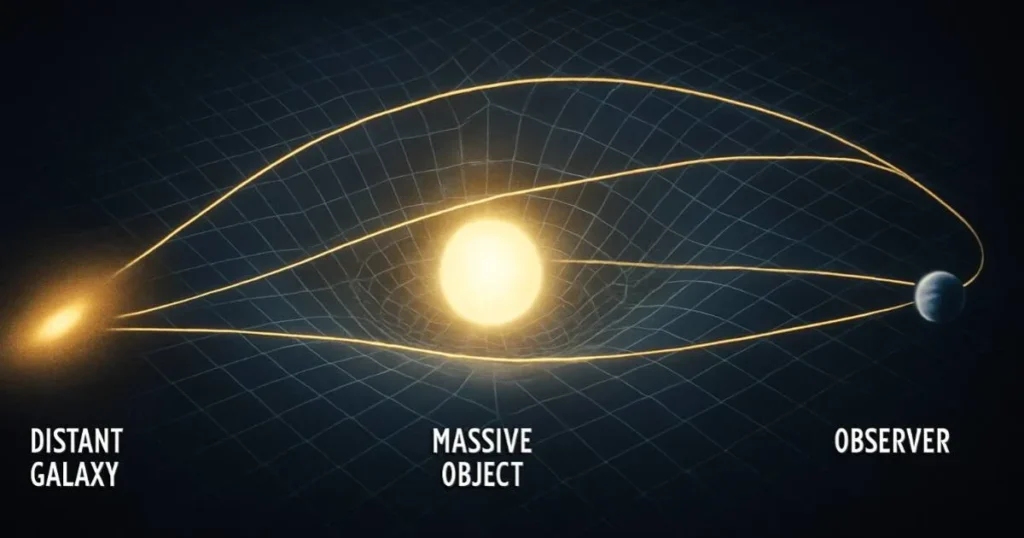
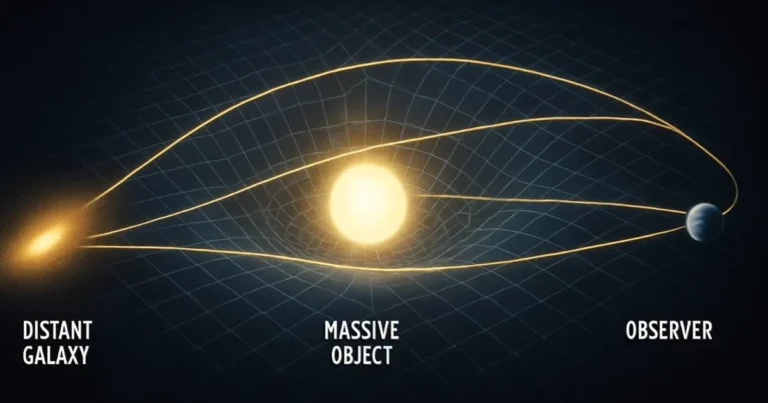
More recently, this unseen mass has been visually separated from normal matter. Because Dark Matter has mass, it bends light from distant galaxies, a phenomenon called Gravitational Lensing (we have thoroughly discussed this topic in our blog post, “Gravitational Lensing: The Astonishing Cosmic Magnifier“). It is basically the way the universe lets us “see” that which shouldn’t be visible. By mapping this bent light, astronomers can effectively “weigh” the total mass of a galaxy cluster.
The definitive proof came with the observation of the Bullet Cluster. This cluster is the remnant of two smaller clusters that recently smashed through each other. During the collision:
- The invisible Dark Matter passed straight through the collision with minimal interaction, creating a clear separation between the bulk of the gravity (the Dark Matter) and the glowing gas (the normal matter).
- The normal, visible matter (hot gases) collided, slowed down, and pooled in the center.
That’s how we discovered dark matter, not by seeing it, but by watching what it does, and now, by seeing where it sits relative to everything else. This evidence confirms that Dark Matter is not just invisible dust or gas, but a fundamentally different substance that interacts almost solely through gravity.
How We Know Dark Matter is Real (Even If We Can’t See It)
So the thing is, We know dark matter is out there due to its effects, not its light. It does not emit, absorb, or reflect any electromagnetic radiation. But its gravitational fingerprints are all over the universe.
The most compelling evidence of Dark Matter comes from gravitational lensing, in which light from a distant galaxy bends as it travels through the gravitational field of a massive object like a cluster of galaxies. This bending is often too great to be explained by visible matter alone.
Such lensing patterns have been mapped by astronomers. Time after time, they indicate large halos of invisible mass around galaxies, and thats dark matter.
What Could Dark Matter Be Made Of?
It is at this point that things take a turn for the surreal. Researchers have given several theories and possible explanations for what dark matter might be made of. The two most promising models are the following:
WIMPs (Weakly Interacting Massive Particles)
WIMPs are hypothetical particles that interact in only two ways: either through gravity or the weak nuclear force, which is why these particles are named so. They would be very massive, stable, and elusive particles. If WIMPs exist, they are passing through you this very second, passing through every atom in your body without hitting them.
Experiments such as LUX-ZEPLIN and the recently launched XENONnT are hunting for them aiming to catch the very rare moment when a WIMP might bump into a normal particle.
Axions − The Light Weight Ghost Particles
Axions are another proposed entity with the help of which the dark matter could have formed, these being extremely light, almost massless particles, potentially drifting through the universe like a mist.
Interestingly, axions might also clump together to create a new type of weird structure known as Axion Stars. This subject has also been extensively explored by me in my post on Axion Stars: Unveiling the Hidden Dark Matter Stars. These theoretical bodies might also be faintly glowing through specific signs of electromagnetic signatures, offering a potential way to detect dark matter indirectly.
Some researchers have actually proposed theories saying that maybe dark matter is some kind of combination of both WIMPS and axions, interacting in ways which are just beginning to reveal themselves.
Dark Matter and the Cosmic Web
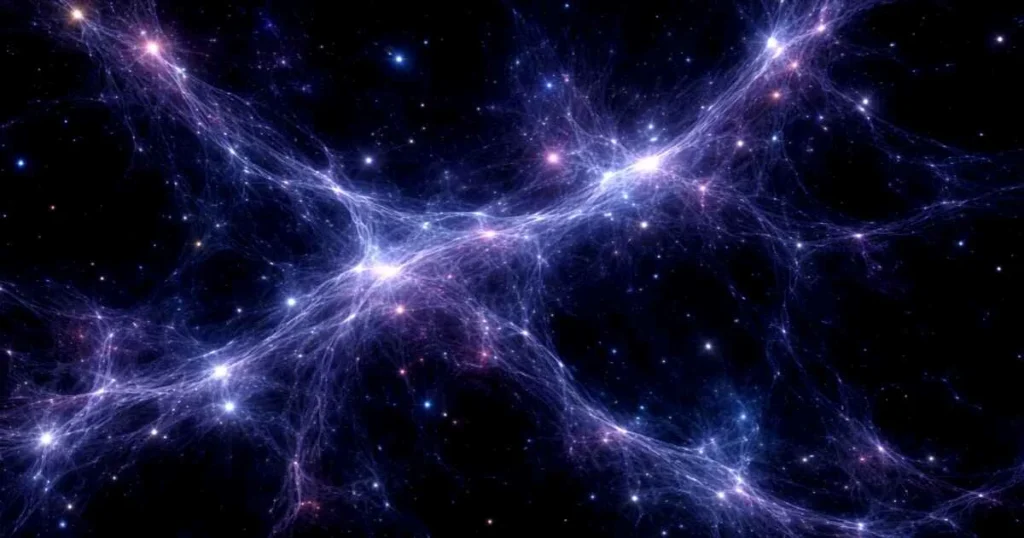
If dark matter were visible, the universe would appear to be one large cosmic network of galaxies connected through space.
Galaxies do not exist in a random fashion, but in fact form clusters of galaxies along the filaments of the cosmic network. The voids between the clusters are primarily empty space, as the majority of the material is located within the filament structures. It’s both eerie and beautiful, like the universe has its very own neural network.
I actually wrote about this idea in Cosmic Filaments – The Universe’s Astonishing Neural Network And it’s wild how dark matter seems to serve the same role as “connective tissue” in the universe, tying everything together. Without it, the galaxies would never have formed. The structure of the universe itself would appear utterly different.
Dark Matter vs. Dark Energy – What’s the Difference?
Dark Matter and Dark Energy are often confused, even though they are the two completely different things. For example, Dark Matter pulls objects together; in fact, it holds all the Galaxies and galaxy clusters in place via its Gravitational force.
Contrary to Dark Matter, Dark Energy pushes objects away from one another. Dark Energy is responsible for the universe’s accelerating rate of expansion.
The universe is estimated to consist of 27% Dark Matter and 68% Dark Energy, with the remaining 5% being what we can see (stars, planets, galaxies, etc.).
Take some time to think about this amazing statistic: only 5% of the universe is made up of things that we have physical evidence for and can understand!
Conclusion: The Universe’s Dark Backbone
Dark matter isn’t simply a curiosity; it is the dark, hidden framework of the universe. Dark matter shapes how galaxies look and how large cosmic structures are created. Dark matter also exists in a way we can’t see, yet it influences gravity throughout the universe.
We currently do not know what dark matter consists of, nor do we know where it came from; however, that ambiguity adds intrigue to dark matter because once we do detect dark matter, it will change how we view everything in the field of physics.
Because when you find what’s been shaping the universe from the shadows, you’re not just solving one mystery, you’re uncovering the story of everything.
Comments
Please log in to leave a comment.
Related Posts
Unlocking Time Crystal Behavior in Neutron Stars
Neutron stars may hold the strangest secret yet: time crystals, repeating not in space but in time. If proven, this idea could rewrite physics itself.
Axion Stars: Unveiling the Hidden Dark Matter Stars
Axion stars are hypothetical celestial objects composed entirely of dark matter particles called axions. These mysterious stars could mimic neutron stars while emitting unusual signals, offering a potential key to unlocking the true nature of dark matter and reshaping our understanding of the universe.
Gravitational Lensing: The Astonishing Cosmic Magnifier
Explore how gravitational lensing bends light, magnifies distant galaxies, and reveals dark matter—unlocking the secrets of the cosmos.