Voyager 1 One Light-Day Away: The Historic Milestone
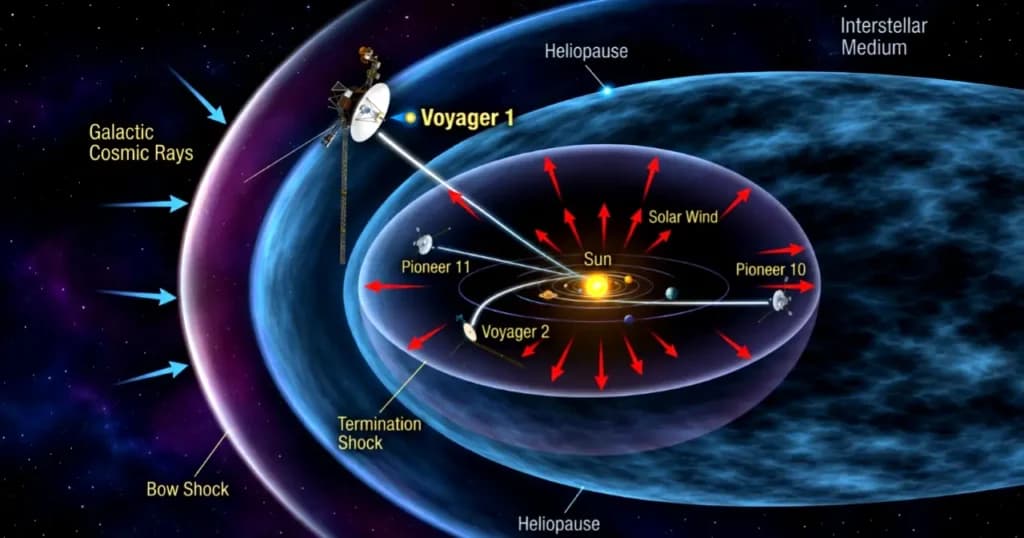
An illustration showing Voyager 1’s journey beyond the heliosphere, where the spacecraft enters the interstellar medium after crossing the heliopause.
Nearly 50 years after leaving Earth, NASA’s Voyager 1 spacecraft is about to become the first human-made object to reach the milestone of Voyager 1 one light-day away from Earth. The milestone is expected to complete on Wednesday, November 18th, 2026, at 5:16:07 a.m. EST (10:16:07 UTC), when Voyager 1 will be approximately 16.1 billion miles (25.9 billion kilometers) away from us. But how far is this distance?
Just for consideration, at that distance, a radio message sent from Earth will be a reminder for all of us that how far a machine built in the 1970s has travelled, and how, after all these years, we are still listening. And next year, it will complete a half-century, imagine 50 years of a non-stop, never-ending voyage away from us in search of something that we can only watch in science-fiction movies.
Voyager 1 Is About to Reach One Light-Day From Earth
You must have heard light-year is your science textbooks that it is the distance travelled by the light in a year, making it a unit of distance, not time. In similar way, light-day is also a unit of distance, not time. It describes how far light travels through space in 24 hours: approximately 25.90 billion kilometers. (300,000*60*60*24=25,920,000,000), you can count the zeroes. And as per the calculations made by NASA, Voyager 1 will reach this mark at 5:16:07 a.m. Eastern Standard Time on November 18th.
However, that number can be difficult to picture as light travels nearly 300,000 kilometers every second, yet, Voyager 1 has taken 49 years, 2 months and 11 days to travel one light-day away from the Earth. Currently, Voyager has a speed of roughly 61,000 kilometers per hour, making it one of the fastest objects made by humans and even faster than Human standards, but remarkably very slow compared with light which is the fastest known object of the Universe.
The milestone is a distance marker, not a physical boundary. Nothing special is going to happen to the spacecraft as it crosses this major milestone. It’s just that it will change our perspective of how do we see the Universe and its extent. However, Earth will be a full light-day behind its most distant robotic explorer.
A Conversation With Voyager 1 Will Take About 48 Hours
The distance has a very practical consequence. Voyager 1 communicates with Earth using radio signals, which we know travel at the speed of light. Once the spacecraft reaches one light-day away, a signal from this spacecraft will take about 24 hours to arrive. And if we were to send any signal as a response to this spacecraft, that will also take a full day to reach.
This, in simple words, means that a simple exchange, send a command, wait for the spacecraft to respond, can take around two days. It’s not like sending a message to someone in social media where you can get a response within seconds but here you have to be patient as you are not dealing with your personal life related communication, you are dealing with a Universal level communication. Engineers has to plan commands carefully, allow time for the signal to travel, and then wait for confirmation that the spacecraft received and carried them out.
Engineers operates on various objects sent to space like a data from a satellite or a rover, but this is one reason (waiting for 2 days in order to complete a communication) operating Voyager 1 is so different from controlling a nearby satellite or rover. The team cannot react instantly to every development happening with the spacecraft.
From Earth to Interstellar Space: Voyager 1’s 49-Year Journey
Voyager 1 launched on 5th of September, 1977, on a mission to explore the outer Solar System. And it took almost 2 and 3 years respectively to fly past Jupiter in 1979 and Saturn in 1980, returning observations that transformed scientists’ understanding of the giant planets and their moons.
The spacecraft’s journey did not end with those encounters. In 1990, Carl Sagan, an American astronomer and planetary scientist asked NASA to turn back its cameras toward home and captured the image that he called the “Pale Blue Dot”: as our Earth is seen appearing as a tiny point in a beam of sunlight. And one of the major milestones achieved by Voyager 1 in August 2012 was that it crossed the heliopause, the outer boundary of the Sun’s solar-wind bubble, and entered interstellar space from where it has continued its journey through the eternity.
That distinction matters. You may wonder that Voyager 1 has left the heliosphere, so it won’t be affected by Sun’s gravity then the answer is that it has not escaped the Sun’s gravitational influence or travelled beyond the Solar System in every possible definition. It is now exploring the space between stars, sending measurements from a region no spacecraft had directly studied before and helping us to explore what may exist in Interstellar Space.
How Long Can Voyager 1 Keep Communicating With Earth?
Like several telescopes, rovers or satellites, Voyager 1 does not rely on solar panels. It gets electricity from radioisotope thermoelectric generators, or RTGs. The radioactive decay of Plutonium-238 is used by these devices to turn heat energy released into electrical power. As the plutonium decays, the available power gradually falls.
Approximately 4 watts of electrical output is lost by the generators each year, as NASA says. Therefore, Engineers have been switching off heaters and scientific instruments, while finding ways to reduce the spacecraft’s energy use. NASA engineers in September 2026, completed power-saving effort, replacing three devices with lower-power alternatives so as to keep the spacecraft active for a much longer period. As the spacecraft has obsolete technology, therefore, sometimes NASA looses communication an faces interruptions in communication and in last October NASA reported that the spacecraft also recovered from a brief communications interruption.
Operating from such a long distance, Voyager 1 is still returning data, sadly its operating life is limited because of its dwindling power. However, the exact date of its final transmission is not guaranteed as it depends on the spacecraft’s condition and the decisions engineers shall make to preserve its remaining systems. But the fascinating thing is that even it can no longer communicate with us, it will continue travelling through interstellar space.
And perhaps, it shall journey far beyond the boundaries of human imagination – beyond the lives we spend sitting, eating, reading, sleeping, wondering, dreaming, and thinking. And may be there will be a time when we humans will have to go through a period of another pandemic, famine, climate change and several other things that can possibly eradicate human’s existence from the Earth or may the story of humans be faded into silence, but Voyager 1 will continue its lonely voyage through the endless.
The Golden Record and NASA’s Global Celebration
The most important thing that Voyager 1 carries with itself is something more personal than scientific instruments: the Golden Record. This Golden Record is a gold-plated copper disc which was designed as a message from Earth to any possible future discoverer but this Golden Record is far much more than a message it contains sounds of our planet, music, images and spoken greetings in 55 languages casted into a disc hoping that someday, somewhere a distance civilization might discover a little piece of us and it can also be considered as a symbol of humans that has been lost to space.
However, it was never a guarantee that another civilization would find it. It is, perhaps, a snapshot of humanity sent into the unknown or into the endless.
However, on 18th November NASA is marking the one-light-day milestone with a worldwide event called “Shine Bright for Voyager’s Light-Day.”And to celebrate it NASA has invited people after sunset on Tuesday, November 17, people to shine a flashlight, phone light or other source skyward and flash “V-G-R” in Morse code. NASA has also provided an automated flasher.
Perhaps the light will not meaningfully reach Voyager 1 as a communication signal. The gesture is considered to be symbolic as people across Earth joining in to celebrate a spacecraft that has carried a piece of our world farther than anything else we have built and that can keep the existence of humans alive even after we are gone.
A Day Away, But Still Connected to Earth
Voyager 1’s one-light-day milestone is more than a distance record but it’s a triumph of Science. It also captures nearly half a century of engineering, patience and curiosity. Launched in 1977, this distant messenger continues to whisper stories of our world back to Earth, though each message now take an entire day to find its way home.
Perhaps, one day, its fading power will surrender, and Earth will receive its final whisper from remarkable traveler. Yet, Voyager 1 will never truly say goodbye. But, it will keep travelling through the galaxy, through the darkness, carrying the laughter, the beauty of our music and the story of a civilization that dared to dream, dared to look up at the stars and dared to reach them. This traveler from Earth with the Golden Record will carry on its voyage even long after the voices and instruments that sent it there have fallen silent.
Frequently Asked Questions
When will Voyager 1 reach one light-day from Earth?
NASA expects Voyager 1 to reach one light-day on November 18, 2026, at 5:16:07 a.m. EST (10:16:07 UTC).
How far away is Voyager 1?
At the milestone, it will be about 16.094 billion miles (25.902 billion kilometres) from Earth.
How long does communication with Voyager 1 take?
A radio signal will take about 24 hours to travel one way. A round trip takes approximately 48 hours, not including any additional response or processing time.
Is Voyager 1 outside the Solar System?
Voyager 1 crossed the heliopause and entered interstellar space in August 2012. It is outside the Sun’s heliosphere, although it remains within the Sun’s gravitational reach.
How long will Voyager 1 keep operating?
There is no guaranteed final-contact date. Its power supply declines each year, and NASA is conserving energy to keep its remaining science instruments operating for as long as possible.

Vinay Sharma
Contributor at Stellar Illusion with a keen interest in cosmology, planetary science, and the latest developments in space exploration.