Laniakea Supercluster: Our True Cosmic Home
Tags:
- Astronomy
- Laniakea Supercluster
For most of human history, we thought our galaxy was just one island in an endless cosmic ocean. Then we learned about galaxy clusters. Then superclusters. And just when it seemed like we had finally mapped our cosmic neighborhood, astronomy delivered another surprise.
In 2014, researchers discovered that our Milky Way galaxy is not just a member of a local galaxy cluster. No, it is actually a part of a much larger entity called the Laniakea Supercluster, which is a region of space that encompasses more than 100,000 galaxies, all of which are bound together by a single gravitational force. This finding was more than just a new entry in the astronomy textbook. It actually gave us a new cosmic address.
The Laniakea Supercluster is not defined by boundaries or edges. It is defined by motion. By tracing the motion of galaxies through space, researchers were able to identify a massive gravitational system that is quietly holding our galaxy and many others in its gravitational grasp.
To understand Laniakea is to understand where we live in the universe, and how the force of gravity affects the structure of the universe on a cosmic scale.
What Is the Laniakea Supercluster?
The Laniakea Supercluster is a super massive region of the universe that consists of over 100,000 galaxies and stretches 520 million light-years across space. The name of this supercluster is of Hawaiian origin and means “immense heaven.” This is not just a poetic fluff but a literal description of scale.
The thing that makes the Laniakea Supercluster so interesting is that it is not defined by its boundaries. There is no edge that you can point to on a map. The Laniakea Supercluster is actually a region of the universe that is bound together by motion.
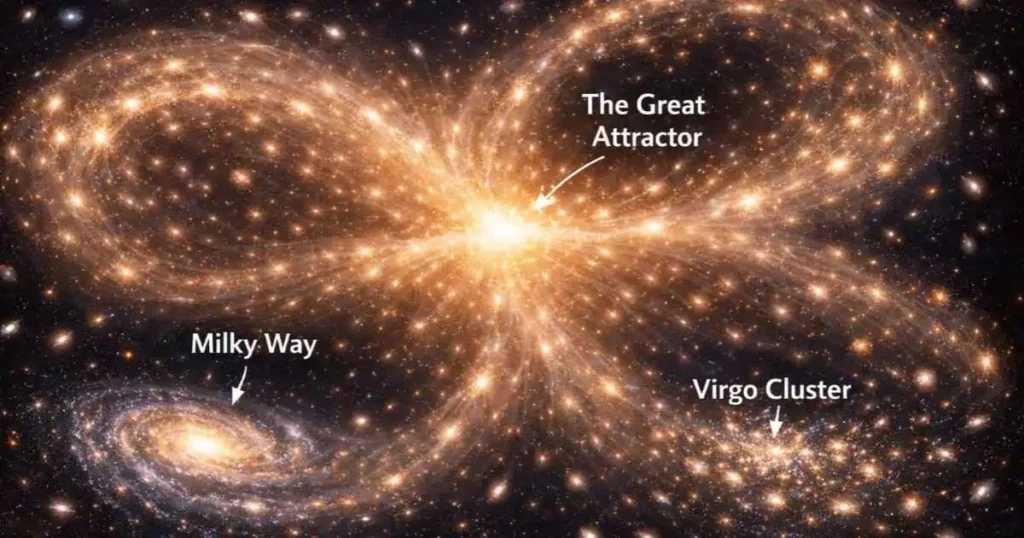
The galaxies in this region are moving in tandem. They are flowing along invisible paths towards a common goal. This common goal is called the Great Attractor.
Why the Laniakea Supercluster Is Not a Normal Supercluster
The traditional way to classify galaxies was based on their proximity to each other. If galaxies were close to each other, they formed a cluster. A collection of clusters formed a supercluster.
However, Laniakea challenged scientists to think differently about how to classify galaxies. Instead of asking “Which galaxies are close to each other?” scientists asked a better question: Which galaxies are moving together?
By analyzing the velocity of galaxies, scientists found that galaxies were not moving randomly with the expansion of the universe. They were actually slightly deviating from their path, attracted by the gravitational pull of a massive region of space that was hidden behind thick clouds of dust.
When these movements were analyzed in three dimensions, the currents showed that there was a massive region of attraction. This region is Laniakea.
The River Analogy That Makes It Click
If the Laniakea Supercluster seems too abstract, consider this analogy:
- Galaxies are Leaves
- Gravity is a River
- The Great Attractor is the Drain
Each galaxy in the Laniakea Supercluster is a leaf on the river. Some move slowly. Some move quickly. But each one of them is on the same river of gravity.
This idea of cosmic flows ties beautifully into the way matter forms large-scale structure. If you enjoyed reading about how galaxies arrange themselves into enormous networks, the concept connects directly with Cosmic Filaments – The Universe’s Astonishing Neural Network, where the universe begins to resemble a vast interconnected brain.
Where Exactly Are We Inside Laniakea?
Here is our complete cosmic address:
Earth -> Solar System -> Milky Way Galaxy -> Local Group -> Virgo Cluster -> Laniakea Supercluster
The final step is the one that humanity has only accomplished recently.
For many generations, the Virgo Cluster was thought to be our largest cosmic neighborhood. Laniakea revealed to us that Virgo is actually just a suburb in a much larger gravitational city. This new understanding has actually changed how our cosmic address is given.
How the Laniakea Supercluster Was Discovered
The finding was made in 2014 by astronomer R. Brent Tully and his team. They studied the velocities of thousands of galaxies, distinguishing between the normal expansion of the universe and what are called peculiar velocities. These are the motions driven by gravity, not the expansion of space itself.
When graphed, these motions did something surprising. They lined up.
Galaxies were moving towards the same part of the universe. When mapped, the motion traced out a single, unified shape. This shape was Laniakea.
This approach was similar in spirit to how astronomers infer invisible mass using gravitational lensing, where light bends around unseen matter. If you want a deeper look at how gravity reveals hidden cosmic structures, Gravitational Lensing: The Astonishing Cosmic Magnifier explores that exact idea.
The Great Attractor and the Dark Side of Laniakea
At the heart of Laniakea lies the Great Attractor, a region of immense mass located in the direction of the Norma Cluster.
We cannot observe it. The dust and gas of our Milky Way Galaxy hide it from us. However, we know it is there because galaxies are attracted to it.
It is composed mostly of dark matter, further supporting the idea that dark matter is the unseen framework of the universe. This is easy to accept in the context of Axion Stars: Unveiling the Hidden Dark Matter Stars, where unusual dark matter objects could have a much bigger role in the universe’s design than we previously thought. Laniakea is more than a group of galaxies. It is a system of gravity ruled by the unseen.
Is Laniakea the Biggest Structure in the Universe?
The answer to the above question is surprisingly, No.
Laniakea is super-massive, but it is not the largest known structure. Even bigger formations exist, such as the Shapley Supercluster, which exerts gravitational influence on Laniakea itself.
This is a disturbing and beautiful observation at the same time. There is no end to the “largest” structure.
The organization of the cosmos goes on and on, with flows merging into flows, and structures inside structures. This nested complexity resonates with the themes of The Cosmic Brain Mystery: Are We Living Inside One?, where the universe starts to look like a self-organizing system rather than a random distribution of matter.
Final Thought: A New Way to Understand “Home”
The Laniakea Supercluster discovery has, in a quiet way, answered one of the oldest questions that humanity has ever asked.
Not “Where did we come from?”
But “Where are we?”
We are not drifting alone in the universe. We are part of a huge flow of matter, moving with thousands of galaxies towards a common destination in the universe. Laniakea shows us that the universe is not only expanding. It is also flowing.
And for the first time in history, we now know which current we are riding.
Comments
Please log in to leave a comment.
Related Posts
Magnetar: The Universe’s Most Extreme Magnetic Monster
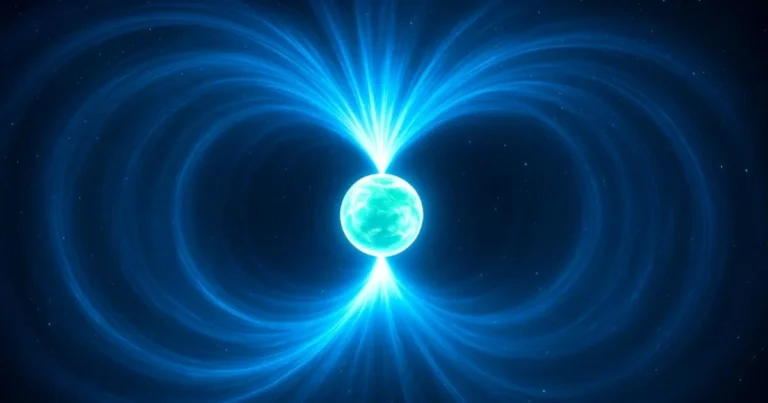
Magnetars are ultra-magnetic neutron stars, cosmic beasts that emit bursts of radiation so powerful they can shake entire galaxies. Learn how they form, what makes them unique, and why their mystery continues to fascinate astronomers.
What Is a Black Hole Shadow? The Ultimate Glimpse into the Abyss
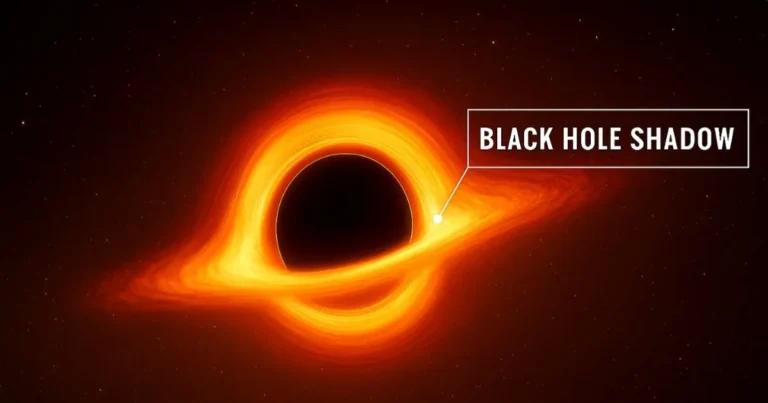
If you could stare into the heart of a galaxy, past the light, past the stars, and into pure darkness, what would you actually see? When astronomers talk about the black hole shadow, they’re referring to one of the most mind-bending sights in the universe, the silhouette of the unseeable, the faint outline of where […]
White Holes: The Universe’s Reverse Gear
If we were to rank the theories that have changed human history forever, the General Theory of Relativity would be at the top. The results it reveals are beyond human understanding. They show that the cosmos is filled with perplexing phenomena, some of which are purely hypothetical yet mathematically elegant. One such phenomenon is the […]